




New Israeli Government Sworn In, Ron Dermer Named to Strategic Affairs Post

 by Andrew Bernard


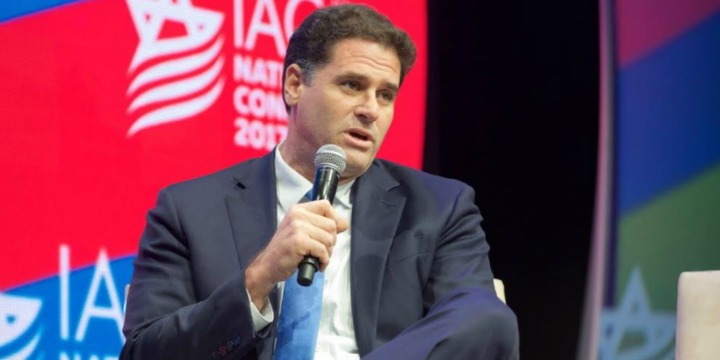
Israeli Ambassador to US Ron Dermer speaks at the Israeli-American Council National Conference in Washington, DC, Nov. 6, 2017. Photo: Perry Bindelglass.
Israel’s new government, led by Prime Minister Benjamin Netanyahu, was sworn in Thursday with far-right MKs Itamar Ben-Gvir and Bezalel Smotrich in charge of the police and finance ministries respectively and former ambassador to the United States Ron Dermer named as Strategic Affairs Minister.
Israeli media outlets reported that Dermer will be Netanyahu’s point man to the Biden administration. He will also be tasked with bringing Saudi Arabia into the Abraham Accords, the 2020 agreement that normalized relations between Israel and several Arab states, and will sit in Israel’s security cabinet, which makes defense and foreign policy decisions. Dermer, who served as Ambassador to the US from 2013 to 2021, had been rumored to be considered for foreign minister, a job that went to Likud MK Eli Cohen.
President Biden welcomed the new government while hinting at potential differences over its policies towards the Palestinians.
“I look forward to working with Prime Minister Netanyahu, who has been my friend for decades, to jointly address the many challenges and opportunities facing Israel and the Middle East region, including threats from Iran,” Biden said in a statement. “And as we have throughout my Administration, the United States will continue to support the two state solution and to oppose policies that endanger its viability or contradict our mutual interests and values.”
Netanyahu announced on Twitter Wednesday that the new government would develop settlements in “all parts of the land of Israel,” including the West Bank, and that Jews have an “exclusive” right to all areas of the land of Israel.
As Ambassador to the US, Dermer was noted for having a difficult relationship with the Obama administration before enjoying warmer ties with former President Trump. The New Yorker reported in 2018 that tensions between Dermer and then-National Security Advisor Susan Rice were so high that the two would not meet alone. Dermer and Netanyahu also accused the Obama administration of orchestrating a 2016 anti-settlement resolution at the UN Security Council, a claim the Obama administration denied.
While Dermer and the Trump administration clashed over proposed Israeli annexation of parts of the West Bank, the achievement of longstanding goals like moving the US embassy to Jerusalem and the Abraham Accords marked a high-point in recent US-Israel relations. Dermer led the Israeli side of negotiations with the US and the United Arab Emirates over the 2020 agreement, which was eventually joined by Bahrain and Morocco. Sudan also signed onto the accords, but suspended the path to normalization following a military coup in 2021.
It is unclear whether Dermer intends to maintain any of the previous assignments of the strategic affairs office, which over the years have included combating the Boycott, Divestment, and Sanctions (BDS) movement against Israel and countering the threat from Iran.
The new government also received the congratulations of Russia’s President Vladimir Putin and Ukrainian President Volodymyr Zelensky. “I confirm Ukraine’s readiness for close cooperation to strengthen our ties and confront common challenges, achieve prosperity and victory over the forces of evil,” Zelensky wrote on twitter.
Netanyahu has visited Russia more times in office than any country except the United States, and in 2019 touted his relationship with Putin on a multi-story campaign poster hung from Likud headquarters. Since the launch of Russia’s further invasion of Ukraine in February, however, Israel has come under pressure from the US and Ukraine to more forcefully back Kyiv. In October, former Defense Minister Benny Gantz offered Ukraine air defense systems, but not weapons.
Speaking at a New York Times event on 1 Dec., Netanyahu said that when Zelensky called to congratulate him on his election victory and asked for Israeli weapons, Netanyahu told Zelensky, “I’ll get back to you.”
Follow Algemeiner Washington Correspondent Andrew Bernard on Twitter @AndrewJBernie