







Artificial Intelligence & Robot Weapons: The Media’s Skewed Coverage of Israel’s Defensive Technology
Error: Contact form not found.

 by Chaim Lax

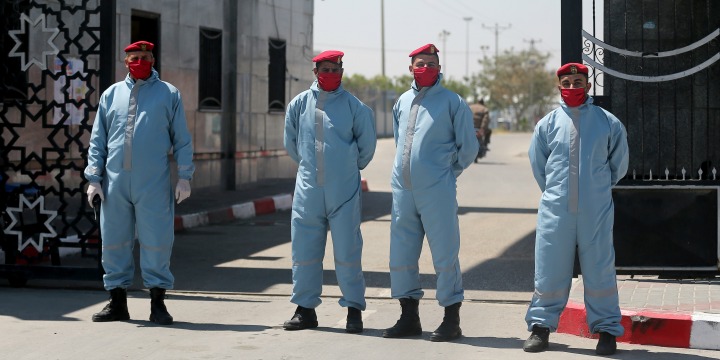
Hamas members wear protective gear as a precaution against the coronavirus disease (COVID-19), at the Rafah border crossing in the southern Gaza Strip, April 13, 2020. Photo: Reuters / Ibraheem Abu Mustafa.
As the development of technology advances at a rapid pace, Israel’s security establishment has continuously worked to integrate the latest innovations into its operations, making them more efficient and effective in defending the Jewish state and its citizenry.
However, over the past few years, several mainstream media organizations have uncritically parroted the claims of politicized organizations that seek to portray these technologies — particularly facial recognition technology and non-lethal automated robotic guns — as immoral and dangerous.
Facial recognition technology maps the features of a person’s face, and then connects it to their identifying information, which is stored in a database. When an image of that person’s face is captured by a camera, artificial intelligence is then able to recognize the person and provide their identity and information to the relevant authorities.
This technology is used around the world in airports, at border crossings, on public transportation, and in other public spaces. This technology has garnered controversy in recent years over its use in the West Bank by soldiers on patrol and at checkpoints, and by its use in surveillance cameras in both the West Bank and Israel.
When Palestinians cross between the areas of the West Bank governed by the Palestinian Authority and areas controlled by Israel, facial recognition software helps expedite the screening process by automatically informing the Israeli authorities whether there are any security concerns with the person crossing over. This is similar to the way that facial recognition technology is used at various border crossings throughout the world.
This “racist technology” significantly reduces average wait times for #Palestinians at a checkpoint to 5 mins.
This standard practice at international borders and checkpoints is unrelated to race.
Pathetic how anti-Israel figures will distort anything to promote their… https://t.co/eKdElw5kzY
— HonestReporting (@HonestReporting) May 7, 2023
With regard to non-lethal weapons, Israel currently operates two of these in the West Bank: In the Al-Aroub refugee camp and in Hebron.
These guns, which are equipped with tear gas, stun grenades, and sponge-tipped bullets, are meant to neutralize the threat posed by violent individuals, or to safely disperse a riot.
When a target is identified, an Israeli soldier locks on the target and presses the trigger. This initiates the artificial intelligence algorithm, which calculates the wind speed, distance, and velocity before firing a non-lethal round at the intended target.
Thus, this automated weapon compensates for human error and reduces the likelihood of innocent people being caught in the crossfire.
Several news outlets produced skewed reports by relying overwhelmingly on sources that are biased against Israel, by making invalid comparisons to authoritarian countries, and by minimizing the security threats that make the use of these technologies necessary.
The New York Times, The Washington Post, and Vox’s coverage of Israeli use of facial recognition technology — along with coverage of the robot guns by the Associated Press and The Daily Telegraph — are overwhelmingly based on sources that are highly critical of Israel, including Amnesty International, Breaking the Silence, Hebron activist Issa Amro, B’Tselem, Human Rights Watch, and others.
These claims made by anti-Israel sources are front-and-center for The New York Times, Vox and the Telegraph, while statements and assertions by Israeli sources are presented briefly and passively. The New York Times even goes so far as to use Amnesty International’s repugnant phrasing “Automated Apartheid” in its headline.
While The Washington Post and AP do provide more coverage to those defending these technologies, the bulk of their reports are still dedicated to those who are highly critical of Israel’s activities.
Furthermore, both The New York Times and Vox equate Israel’s use of facial recognition technology with China’s use of similar technology to identify and repress certain vulnerable minorities.
Facial recognition technology is used by a wide variety of countries, both democratic and non-democratic. By comparing Israel to authoritarian China, both news outlets are creating a false narrative of repression of the Palestinians instead of security for Israelis.
Mainstream media outlets portrayed Israel’s actions as focused solely on monitoring the Palestinians, and as existing outside the realm of acceptable behavior for democratic countries.
However, as noted by NGO Monitor, both of these impressions are false.
There are surveillance cameras that employ facial recognition technology in the Ashdod port as well as Jewish areas of Jerusalem, and there is an initiative underway for this technology to be expanded across the country.
This technology is also used by both Israelis and foreigners entering and exiting Israel through the airport.
Further, the use of this technology is not unique to Israel.
A recent study on the use of facial recognition technology around the world found that Israel used this system less than Australia, the United States, Spain, France, the United Kingdom, Japan, Sweden, Canada, and other democratic countries.
A debate over the usage of such technology in democracies is a valid one. But only Israel, it seems, is subject to the intense scrutiny and skewed focus that has characterized the mainstream media’s coverage in recent years.
One of the most glaring omissions is an understanding of the security situation that necessitates the use of these technologies.
In most reports, the terrorist threat to Israelis is only mentioned briefly in passing, leaving many readers unaware of the security context in which the use of these technologies is taking place.
Thus, the above-mentioned news outlets have produced heavily skewed articles that act more as propaganda items than as serious reports on a complex topic.


