






Discovery of Dutch Prince’s Nazi Membership Card Revives Calls for Inquiry
Error: Contact form not found.

 by Reuters and Algemeiner Staff

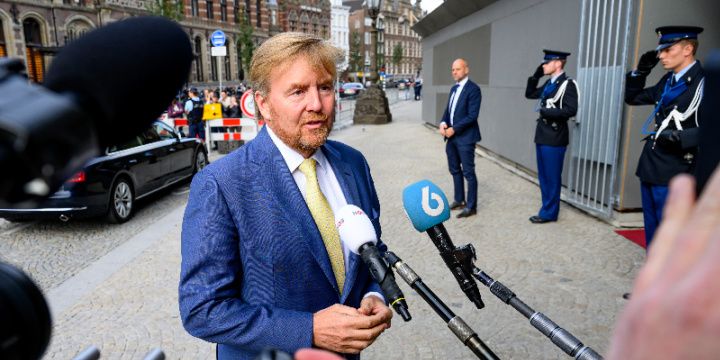
Dutch King Willem Alexander responds to the press on the news that his grandfather Prince Bernhard had a membership card of Adolf Hitler’s Nazi Party in Amsterdam, The Netherlands, Oct. 5, 2023. Photo: Dutch Press Photo/Cover Images via Reuters Connect
The discovery of a Nazi membership card in the name of late Dutch Prince Bernhard, a German who married into the Dutch royal family in the 1930s, revived calls on Friday for an inquiry into his ties to Adolf Hitler’s party.
Prince Bernhard, the grandfather of Dutch King Willem Alexander, died in 2004. He consistently denied having been a Nazi although he did acknowledge membership of several Nazi military units, saying it was common for men of his age at the time.
While there always was suspicion that he was a Nazi Party member, “the discovery of Prince Bernhard’s original NSDAP membership card is a new part of a painful chapter in Dutch history,” the Center for Information and Documentation Israel (CIDI) said on Friday.
It called for an investigation by the Institute for War, Holocaust, and Genocide Studies (NIOD).
“That Bernhard was a member is not so much what caused the shock: most Dutch people had expected that by now. But that he continued to deny it until his death weighs much more heavily for people,” the CIDI said in a statement.
In interviews with the De Volkskrant newspaper shortly before his death, Bernhard had repeated his denial: “I can state with one hand on the Bible, I was never a Nazi,” he said.
The Dutch government confirmed the card was found but has resisted calls for an inquiry.
Born in 1911 as Bernhard von Biesterfeld, he became a Dutch citizen and later flew combat missions for the Allies against Germany during the war.
The card, which showed Bernhard first joined in 1933, was found by historian Flip Maarschalkerweerd, the Royal Information Service said. Maarschalkerweerd told national broadcaster NOS he was surprised that the prince had saved the card he had denied having.
“He was a collector, and palaces have enormous attics and basements,” he said. “Perhaps he forgot he had it.”
As early as 1996 Dutch journalists published a book containing a copy of an NSDAP membership card in Bernhard’s name that was found in US archives, along with correspondence showing that he quit the party in 1936 when he became engaged to Juliana, the Dutch princess who later became queen.
King Willem Alexander said the discovery in Prince Bernhard’s private archive could revive painful memories of the Nazi occupation of the Netherlands during World War II.
“I can very well imagine that this news has a great impact, that it calls up a lot of emotions. In particular among the Jewish community,” Willem-Alexander told reporters on Thursday.
“We have to see the past as it is, including the less nice parts,” he said.