





Hamas and the PA: Exchanging One Genocidal Antisemitic Leadership for Another
Error: Contact form not found.

 by Kenneth Levin

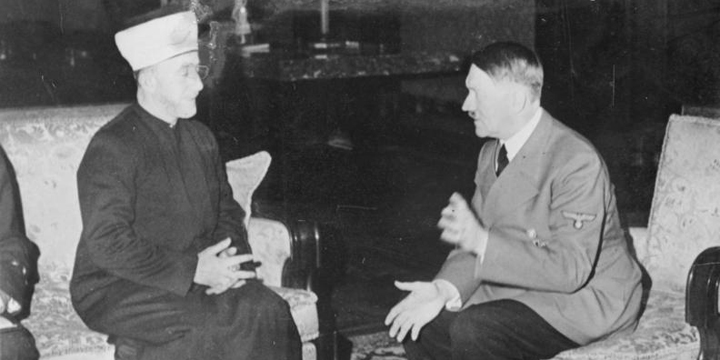
The mufti of Jerusalem, Haj Amin al-Husseini, meets with Adolf Hitler in 1941. Photo: German Federal Archives via Wikimedia Commons.
Who will govern Gaza after the present war? It is not clear that Israel has formulated its vision for a post-Hamas Gaza, but Israel has determined that that future will not include another genocidally antisemitic regime.
In unilaterally withdrawing from Gaza in 2005, Israel had not fully anticipated the Hamas takeover in 2007. Similarly, Hamas’ charter — where the Islamist group states that its goal is to kill all Jews worldwide, and declares this objective to be a religious obligation — did not lead Israel to anticipate the onslaught of October 7. Nor did it prevent the recurrent Hamas rocket attacks targeting Israeli civilians, which triggered four wars in 15 years.
On the contrary, loathe to reoccupy Gaza in response to earlier attacks, Israeli governments had convinced themselves that Hamas could be managed with sharp but limited military responses in wartime, and various incentives between wars.
A similar willful blindness, likewise driven by reluctance to resume its pre-1993 rule even temporarily over the Palestinian population of Judea and Samaria, has shaped Israeli policy towards the Palestinian Authority (PA).
On the very night of the White House ceremony initiating the Oslo peace process and creating the PA, Yasser Arafat, in a Jordanian broadcast, assured his constituency that his goal remained Israel’s annihilation.
When Arafat subsequently took control of much of Judea and Samaria and Gaza, he and the PA used their media, mosques, and schools to promote the objective of Israel’s destruction and the establishment of an Arab state cleansed of Jews.
Despite all this evidence, Israel closed its eyes to the incitement, and to Arafat’s role in the increased terror attacks that followed his entry into the territories. It was only after Arafat launched his terror war in 2000, a war that — together with the losses to terror earlier in the Oslo years — claimed a number of lives comparable to those lost on October 7, that Israel finally rethought its embrace of Arafat as a “peace partner.”
Arafat’s associate and successor, Mahmoud Abbas, has continued the PA’s incitement to genocide.
Abbas and the PA have also promoted Israel’s demise via their “pay to slay” policy that offers financial incentives to those who murder Israelis and to their families. Elements of the PA have also praised Hamas’s October 7 massacre, and some have bragged about PA involvement in that day’s events.
Handing control of a post-Hamas Gaza to the PA would simply be exchanging one genocidal antisemitic leadership in Gaza for another. Yet such a regime is exactly what President Biden seemed to be advocating in a recent Washington Post op-ed. And Secretary of State Blinken has repeatedly declared that he envisions Gaza being handed over to the PA. Even some Israeli leaders are advocating this; most notably Yair Lapid, head of the Yesh Atid party and Israel’s prime minister for six months in 2022.
Unfortunately, there has never been a Palestinian leadership whose political program was not built around genocidal antisemitism. This has been true since the beginning of a Palestinian Arab political movement in the early part of the last century.
The early leader of the movement, Haj Amin al-Husseini, instigated murderous attacks on the Jewish community in Mandatory Palestine in 1929 and again in 1936-39. He spent a considerable amount of World War II in Berlin as Hitler’s guest, and broadcast from Berlin to the Arab world urging support for the Nazis and the murder of all Jews in Arab lands. He also worked with the Nazis on plans for the extermination of Mandate Jews after the anticipated German conquest of the region.
Later, al-Husseini was the leading Palestinian Arab figure in the wake of passage of the United Nations partition plan that called for division of the Mandate into Jewish and Arab states, a plan immediately rejected by the Arab side. In the ensuing war, al-Husseini’s objective and that of his followers and allies was still the annihilation of the Jewish community.
Arafat and Abbas’s Fatah organization, long the dominant force in the Palestine Liberation Organization (PLO), was founded by members of al-Husseini’s Arab Higher Committee and has embraced the same goal of annihilating the Jews.
Ahmed Shukeiry was head of the PLO in the lead-up to the 1967 war. As Arab forces, at the initiation of Egypt, were preparing for what they believed would be Israel’s destruction, Shukeiry declared of the aftermath of the coming hostilities, “Those [Jews] who survive will remain in Palestine. I estimate that none of them will survive.”
On June 24, 2002, then President George W. Bush, having come to more fully understand Arafat’s role in the ongoing terror war he had launched two years earlier — including the PA’s collusion with Hamas and Iran — declared that a change in Palestinian governance to a democratic leadership untainted by terror was a necessary precondition to peace. But is such a change even possible? Would there be support among Palestinians for a leadership that genuinely sought peace with Israel?
Such support was likely more feasible before Oslo. From 1967 to 1993, there had evolved a burgeoning Palestinian middle class in Judea, Samaria, and Gaza. Many of its members, having been exposed to Israel’s democracy over those years, talked of wanting the same type of governance for themselves. But the vast majority of Palestinians today have not known anything but PA rule in Judea and Samaria, and PA — and then Hamas rule — in Gaza. For their entire lives they have been exposed to schooling and sermons and media broadcasts that have indoctrinated them about the necessity of devoting their lives to Israel’s annihilation. Opinion polls in the Palestinian territories have shown overwhelming support for that agenda.
Even Palestinians who, unhappy with life under the PA or Hamas, have emigrated from the territories, continue in large part to support the Palestinian leadership’s genocidal goal. One can see it in the pro-Hamas demonstrations that have filled American and European cities since October 7, and in Palestinian participation in the displays of antisemitism that have scarred American and European academia. One can see it even in the halls of Congress.
To ignore this reality, to suggest that eliminating Hamas’ control of Gaza and then handing the territory to the PA would be a step towards peace, is delusional and lethally dishonest. To not insist on a successor regime that represents a radical break with the Palestinian past and genuinely eschews genocidal antisemitism is simply to court unending repetitions of the crimes of October 7.
Kenneth Levin is a psychiatrist and historian and author of The Oslo Syndrome: Delusions of a People Under Siege.