









Will the US Finally Patch Things Up With Saudi Arabia?
Error: Contact form not found.

 by Shoshana Bryen

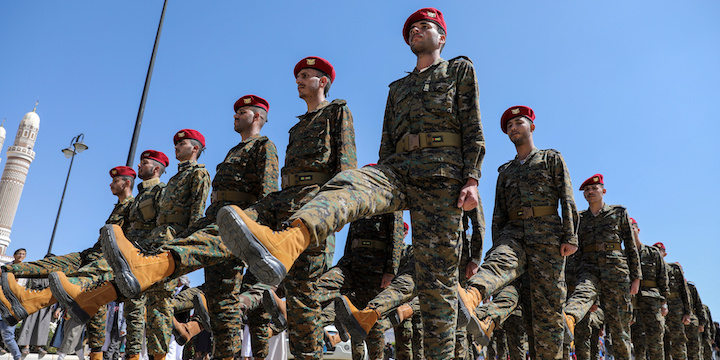
Houthi soldiers march during a funeral procession for Houthi fighters killed in recent fighting against government forces in Marib province, in Sanaa, Yemen February 17, 2021. Photo: REUTERS/Khaled Abdullah/File Photo
The British Ministry of Defense has announced that, “Saudi Arabia and the United Kingdom confirm their commitment to a long-term partnership against the background of the deterioration of security in the Red Sea.”
It is a huge step for Saudi Crown Prince Mohammed bin Salman (MBS), who, after years of harassment by the West — especially the US — may finally be finding allies in the fight against Iranian sponsorship of Houthi terrorists.
Here’s a quick review.
Iran had been harassing shipping in the Persian Gulf — east of Saudi Arabia — since the 1980s. Iranian fast attack vessels charged US Navy ships; their drones buzzed American fighter jets; and their lasers were directed at American helicopters operating at sea. These efforts culminated in the capture of 10 American sailors in 2016. The harassment largely stopped in 2018.
Yet at the same time, Iran was sailing warships in the Red Sea — west of Saudi Arabia. Iran’s former Revolutionary Guards commander, Qassem Soleimani, declared in 2018, “The Red Sea, which was secure, is no longer secure with the American presence.”
The encirclement of Saudi Arabia by Iran did not seem to move the US. Also in 2018, the US Senate “voted to end American military assistance for Saudi Arabia’s war in Yemen,” wrote The New York Times in an article that never mentioned Iran.
Senators were angry with MBS. “We have been led into this civil war in Yemen, half a world away, into a conflict in which few Americans that I know can articulate what American national security interest is at stake,” said one senator. President Joe Biden piled on, calling MBS a “pariah,” and Biden removed the Houthis from the US terror-sponsor list in 2021.
Senators often aren’t strategic thinkers — nor are presidents, actually — but a map might have helped.
Iran, which has no border on the Red Sea, was able to encircle Saudi Arabia by virtue of its base in the heel of the Saudi boot, i.e., in Yemen. Its hostile presence in the Red Sea also undermined Egypt, Jordan, and Israel. It allowed access to overland routes through Somalia, Eritrea, and Sudan — and directly into Egypt — for the purpose of arming rebels along the coast and the militias that Egypt fought in the Sinai desert (with Israel’s help).
The Red Sea is the only Israeli outlet to the Gulf of Aden and then the Arabian Sea, the route of Israel’s trade with India and Asia. It is Jordan’s only sea outlet, and the Eilat-Aqaba Free Trade Zone is a major source of trade revenue for Amman. For Egypt and the rest of the world, it is the route to and from the Suez Canal — which is essential for international trade, including oil trade.
Therefore, Iran stoked the Houthi insurrection in Yemen, providing, among other things, long-range missiles that were fired into Riyadh. US warships have intercepted a large number of Iranian weapons shipments intended for Houthi militias.
Other shipments have been intercepted coming overland from Oman. While President Biden delisted the Houthis, the UN Security Council renewed its sanctions on them in November, but allowed sanctions on Iran to expire.
If security and freedom of navigation for Red Sea allies are not sufficient reasons for the United States to be concerned with Iran, consider this: Camp Lemonnier, the US naval base, sits directly opposite Yemen, off Djibouti. Camp Lemonnier is operated by the Combined Joint Task Force Horn of Africa (CJTF-HOA) and the US Africa Command (USAFRICOM) — and is the only permanent US military base in Africa.
The map, again. The countries north of the Mediterranean Sea are European, all of which except Bosnia are NATO members. Facing them, along the North African coast, are Sunni Muslim countries, all of which except Libya are partners in NATO’s Mediterranean Dialogue. The arrangement helps keep the Mediterranean stable and free for shipping.
One way to make North Africa less stable is to make the row of countries underneath it less stable. Chad, Mali, Somalia, Eritrea, Sudan, and Niger all are targets of instability seekers, including Iran. They are, to be sure, as much targets of Sunni jihad as they are of Iran, but Iran’s massive infusion of funds supports Sunni Hamas, al Qaeda, ISIS, Boko Haram, al Shabab, and others.
Instability, chaos, anti-Americanism, anti-Israelism, anti-Westernism, and anti-Christianity are what Iran seeks — and they are what Sunni jihadists seek.
Now the West appears suddenly to have remembered the importance of freedom of navigation and Saudi Arabia may have found allies. If they can make the connection to the sponsor of Houthi terror — Iran — an alliance may be able to right the ship, so to speak. But we’re a long way from it.
The author is Senior Director of the Jewish Policy Center. A different version of this article was previously published by The Daily Caller.


