





How Artificial Intelligence Is Helping Israel Fight Enemies Online and in Gaza
Error: Contact form not found.

 by Troy O. Fritzhand


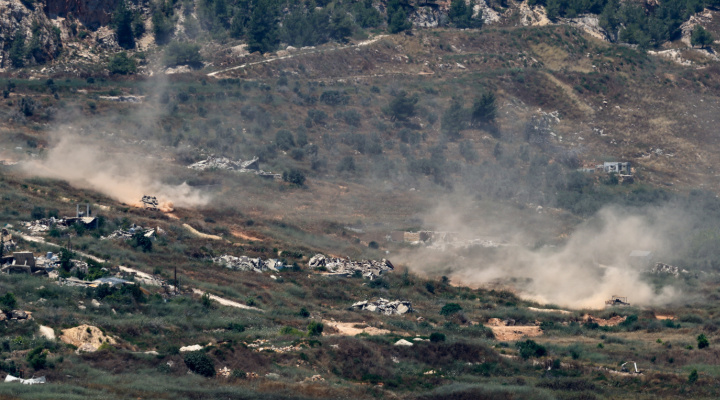
Israeli soldiers fire mortar shells, amid the ongoing conflict between Israel and Hamas, near Israel’s border with Gaza in southern Israel, Jan. 3, 2024. Photo: REUTERS/Violeta Santos Moura
Artificial intelligence (AI) has emerged at the forefront of the information war being waged alongside the military battlefields in Gaza, with the Jewish state using the revolutionary technology to bolster its efforts both online and on the ground.
Shiran Mlamdovsky Somech, a leader in the AI field and the founder of Generative AI for Good, has been one of the Israelis leading the effort on the web.
“We are the Startup Nation,” she told The Algemeiner in an interview about how her organization has shifted its activities since Hamas’ Oct. 7 massacre in Israel and the start of the war in Gaza.
Utilizing generative AI — photos, videos, or audio that have been generated with AI to depict a person’s likeness — her team created videos of two children being held hostage by the Hamas terror group in Gaza begging to return home. The videos were seen by 5-10 million people around the world, Somech said.
“The campaign, conducted in full collaboration with the families of the [Oct. 7] victims, includes a series of animated and dubbed real facial images of the hostages, allowing them to ‘speak’ from their own mouths in English and German and reach out to the hearts of everyone in the world,” she said. “It was clear to me that if we were to undertake such a project, it needed to be done carefully with the necessary sensitivity, both in terms of the families’ consent and the quality of the result, in full compliance with ethical standards and responsible use of AI. And of course, we operated transparently and as part of the creative, we emphasized that we are using AI to give a voice to people who are currently silenced.”
The challenge has grown, however, as antisemitism, especially hatred of Israel, has expanded.
“It is in academia too. There is a new antisemitism. It is not just against Jews; it is against Israel and Zionism,” Somech said. As a result, her group has sought to work in the world of education, both in Israel and abroad, especially through social media.
Prior to Oct. 7, when Hamas terrorists stormed southern Israel, killing more than 1,200 people and taking 240 hostage, Somech helped to spearhead impactful campaigns in the AI field.
“People were talking about how dangerous the AI could be, but after thinking, and we can do it in a responsible and ethical way, we came to realize the technology could be used for good,” she said.
In 2021, Somech started a project called “Listen to My Voice,” which utilized AI technology to create a video of Michal Sela, an Israeli social worker who was murdered at home by her husband in 2019, educating and warning about domestic violence and urging women in relationships where they feel at risk to seek help.
“The campaign went viral immediately, reaching more than 10 million people … We were on TV and everyone was talking about it,” she said. The program was presented at NATO, Israel’s parliament, and the United Nations.
From there, Somech worked with the International March of the Living, a Holocaust education program, as her organization created an AI campaign showing the fighters of the Warsaw Ghetto Uprising, the largest Jewish revolt against the Nazis, describing their bravery — again using real photos and authentic quotes.
As for the current battlefield, the Israel Defense Forces (IDF) is reportedly using AI to produce targets for aerial bombings — tens of thousands so far. The system, known as the Gospel, allows the IDF to quickly identify Hamas terrorists, helping to limit civilian casualties in a war in which Hamas embeds itself in civilian areas including hospitals.
According to a study by the Action on Armed Violence nonprofit group, the ratio of civilian casualties is 10.1 for IDF air strikes. To compare, the ratio was 15.3 civilian deaths per air strike for US and allied operations carried out in Mosul, Iraq against the Islamic State (ISIS). The global average is 7.4 civilians per strike.
The Gospel system is estimated to produce more than 100 targets per day for Israeli pilots.
Another tool is Liri’s Smile, an AI system made for families of those being held hostage in Gaza. The system allows for the uploading of photos and images of their loved ones, which the system can automatically scrape the internet to find matches and give information about the missing to security forces.
“Using AI, responsibly and ethically, we can do good,” Somech said, eager to continue her work on behalf of Israel.
CORRECTION: An earlier version of this article incorrectly stated that 0.8 civilians die on average from each IDF injurious air strike, according to a study from the Action on Armed Violence nonprofit group. The correct number is 10.1.