





Bias-as-a-Business-Strategy Won’t Rescue the New York Times
Error: Contact form not found.

 by Ira Stoll

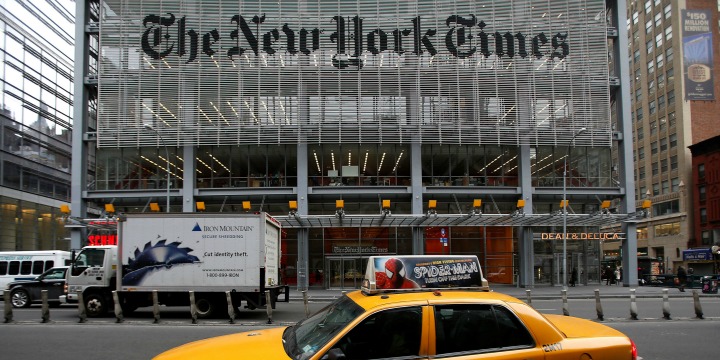
A taxi passes by in front of The New York Times head office, Feb. 7, 2013. Photo: Reuters / Carlo Allegri / File.
A long front-page article in the New York Times faults Israel for killing journalists in Gaza, claiming that has inhibited the world from seeing what is happening there. The article, though, fails to fault Hamas for its role in impeding journalism. And it also strangely omits the evidence that at least some of the Gazans portraying themselves as journalists are also members of terrorist organizations.
The Times article carries the online headline, “The War the World Can’t See.” A subheadline claims that because of the challenges faced by local journalists, “From outside Gaza, the scale of death and destruction is impossible to grasp.”
That claim of invisibility may seem like a stretch to Times readers who have been following the Times’s own endless coverage. The Times has featured satellite images of destroyed Gaza buildings, interviews with doctors describing Civil War-style carnage at the hospitals that shelter Hamas tunnels the doctors claim to be unaware of, interviews with United Nations officials describing thirst and hunger (while the same officials studiously downplay discussion of the involvement of UN workers in the October 7 terrorist attack on Israel. Somehow the protesters clogging Ivy League campuses and European cities have managed to get word of the Gazan suffering notwithstanding the Times’ worries about “communications blackouts.”
The Times goes on to cast blame for the supposed dearth of journalistic exploration of Gazan suffering. The culprit is—you guessed it—Israel. “At least 76 Palestinian journalists have been killed in Gaza since Oct. 7, when Hamas led an attack on Israel and Israel responded by launching an all-out war,” the Times says. “Nearly all the journalists who have died in Gaza since Oct. 7 were killed by Israeli airstrikes, according to the Committee to Protect Journalists, 38 of them at home, in their cars or alongside family members. That has led many Palestinians to accuse Israel of targeting journalists, though CPJ has not echoed that allegation.” Many Palestinians have all sorts of sinister and conspiratorial accusations against Israel; it’s the Times‘s job to debunk them or at least to fact-check them thoroughly, rather than just providing a megaphone to them.
The Times article quotes “Khawla al-Khalidi, 34, a Gazan TV journalist for Al Arabiya, a well-known regional Arabic-language TV channel,” who says, “Israel is afraid of the Palestinian narrative and of Palestinian journalists…They’re trying to silence us by cutting the networks.”
Not mentioned at all in the Times article is the news that, according to the Israel Defense Forces, two of the “journalists” listed as Gaza casualties, Hamza al-Dahdouh and Mustafa Thuria, “were members of Gaza-based terrorist organizations.” The IDF said, “Documents found by our troops in Gaza revealed Thuria’s role as Squad Deputy Commander in Hamas’ Gaza City Brigade, as well as Al-Dahdouh’s roles in the Islamic Jihad terrorist organization’s electronic engineering unit and previously as a deputy commander in IJ’s Zeitun Battalion.”
The IDF said the two were targeted while operating a drone, “posing a threat to our soldiers.” That would seem like a relevant fact to include in a Times article that carries accusations of Israel trying to squelch the Palestinian narrative by killing journalists.
The Times article also entirely excludes the fact that Hamas restricts, with threat of violence, the activities of journalists in areas that it controls. The Times has let this slip at least once—”Hamas restricts journalists in Gaza,” the newspaper’s Jerusalem bureau chief, acknowledged back in November, but that concession is somehow missing from this latest Times article, which is all about restrictions on journalism in Gaza.
The Times article also carries, as one of three bylines, that of Abu Bakr Bashir. A web page for the “refugee journalism project” reports that Bashir “fled” Gaza in 2019 “when Hamas, the militant Islamic nationalist group that governs the territory, tried to control his reporting.”
Why does the Times article have such a slant? One might chalk it up to anti-Israel bias by the newspaper’s management, or to the particular editors and reporters who handled this piece. Certainly possible. But then what explains the willingness of the Times also to publish articles such as one about “How Hamas Weaponized Sexual Violence on Oct. 7” or others on the extensive nature of the Hamas tunnel network underneath Gaza?
One explanation that fits the pattern is a business-and-technology driven shift by the Times to emphasize headlines and stories that will be clicked on and shared socially by partisans of both sides in the Israel-Hamas war. Rather than trying to make each individual story balanced, the Times is publishing a variety of stories that it can claim together mount up to a nuanced and accurate portrayal of the reality. That seems to me like a dodge, because a lot of readers don’t read the full Times report, they just read a single story at a time when the story is shared socially.
It’s one thing to take such an approach on the opinion pages, where the Times offers Bret Stephens columns to be read and shared by Israel-lovers alongside Nicholas Kristof columns to be read and shared by Israel-haters. What’s new in the Israel-Gaza war is that the Times is taking a similar approach in the news articles, which, unlike the opinion columns, used to aspire, at least ostensibly, to a sort of above-the-fray balance.
It’s not clear the new Times strategy is a business success. The company’s stock price is down more than 8 percent year to date as of February 8, and plunged this week when the company released its fourth quarter results. The overall stock market, meanwhile, is up. But the Times management compares itself to places such as the Washington Post, the Los Angeles Times, and Sports Illustrated, which appear to be doing even worse, business-wise. So keep an eye out for more of the “bias-as-a-business strategy” approach.
Ira Stoll was managing editor of The Forward and North American editor of The Jerusalem Post. His media critique, a regular Algemeiner feature, can be found here.