








Counting Jews in Israel: The ‘Other’ Is Not Enough
Error: Contact form not found.

 by Jacob Sivak

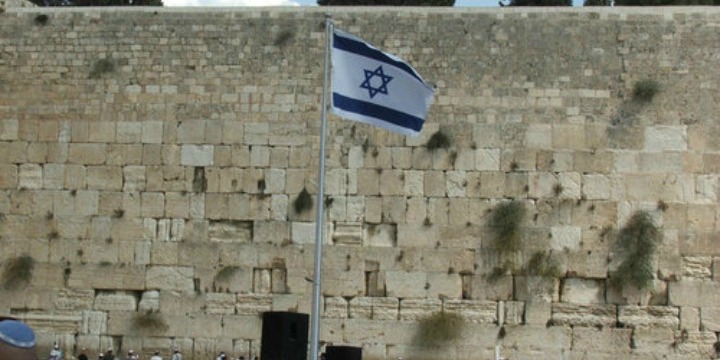
The Israeli flag at the Western Wall in Jerusalem. Photo: Hynek Moravec via Wikimedia Commons.
On November 7, 2023, just one month after the Hamas massacre of Israelis and the onset of the war in Gaza, The Jerusalem Post’s Zvika Klein reported on a surge of interest in immigration to Israel by French and American Jews. So, it comes as no surprise that on February 14, 2024, the Israel Minister of Aliyah and Integration announced that, in spite of an ongoing war, 6,500 new immigrants had arrived in Israel since October 7, including a significant number from Western countries such as the US and Canada. According to the Minister, this burst of immigration is due mainly to a sense of solidarity with Israel, rather than a result of antisemitism.
The latest population report from the Israel Central Bureau of Statistics notes that as of January 1, 2024, close to one-half (47%) of the world’s 15.2 million Jews live in Israel. In addition, fertility values for Israelis have been consistently high, by far the highest of the 38 developed countries that make up the OECD. In a recent article, Ofir Haivry writes that two thirds of all Jewish babies are born in Israel. Thus, it is a safe bet to say that a majority of the world’s Jews will probably live in Israel by 2048, the centenary of the state, and possibly sooner.
The Central Bureau also reported that the population of Israel stood at 9,842,000, as of January 1, 2024. (The number includes Jewish settlers in the West Bank, but not Palestinians living in the West Bank and Gaza.) This is more than a ten-fold increase over the population of Israel when the state came into being 75 years ago, and a substantial 1.9 % increase over the previous year. The number of Jews was listed as 7,208,000, (73.2 %) and Arabs as 2,080,000 (21.1 %).
What about the missing 5.7 %? This demographic is listed as “others,” and includes groups such as Baha’is, Karaite Jews, Samaritans, Messianic Jews etc. What the Central Bureau does not state explicitly, is that many in this group — more than one-half million people — are immigrants from the Former Soviet Union (FSU), most recently from Russia and Ukraine. While most self identify as Jewish, they do not satisfy the Orthodox definition used by the government for civil procedures such as marriage etc. (Ironically, the Central Bureau also reports that close to one-half of Jewish Israelis consider themselves to be secular.)
These citizens of Israel immigrated to the country, either as spouses of Jews, or under the regulation stipulated by the Law of Return, which gives the right to anyone with one or more Jewish grandparents to apply for Israeli citizenship. This does not agree with Jewish law (Halacha), but it does coincide with the definition used by the Nazis to define a Jew.
These people participate in Israeli democracy, they speak Hebrew and celebrate the rites of the yearly Jewish calendar, and they and their offspring serve — and indeed some die — in the IDF. According to Sue Surkes in a recent Times of Israel article, these “others” from the FSU accounted for 20% of Israel’s population growth in 2023. She also notes that data from a Labor Force Survey indicate that this is the cohort with the highest employment numbers, and the longest work hours of any group in Israel. They are an essential component of the Israeli economy,
To Jews the designation “other” — acher in Hebrew — should bring to mind the story of Elisha ben Abuyah, the first century CE rabbi and sage who was ostracized by his peers for straying from Jewish particularism to a Hellenistic view of the world. Elisha, a colleague of Rabbi Akiva, teacher of the great Rabbi Meir, and one of the estimated 120 Tannaim, or teachers, responsible for writing the Mishna during the early Talmudic period, was referred to later in the Talmud not by name but as acher.
Rather than the vague and insensitive category “others,” it would be more accurate to specify that the demographic makeup of Israel today includes 7.7 million Jews, 7.2 million of whom are Jewish according to religious law. The sum represents approximately 75% of the total population of Israel.
Jacob Sivak, a Fellow of the Royal Society of Canada, is a retired professor, who taught at the University of Waterloo.


