





Corrections Are Not Enough: Washington Post Misquotes Israeli Expert, Then Inserts Hezbollah Propaganda
Error: Contact form not found.

 by Simon Plosker


Hezbollah members hold flags marking Resistance and Liberation Day, in Kfar Kila near the border with Israel, southern Lebanon, May 25, 2021. Photo: Reuters/Aziz Taher
Lieutenant Colonel (Res.) Sarit Zehavi, the founder and president of Alma — an independent research and education center focused on Israel’s security challenges along its northern border — has become a sought-after commentator amid Israel’s ongoing strikes on Hezbollah targets in Lebanon.
Following the elimination of the terrorist organization’s leader, Hasan Nasrallah, it’s no surprise that the international media have turned to her for insight.
However, it was extremely surprising to see comments in The Washington Post connected with Zehavi that implied the Galilee region in northern Israel is “disputed” territory.
After confirming with Zehavi, she clarified that she had never made any statement during her interview with Washington Post journalist Loveday Morris that could be interpreted in that way.
No, @washingtonpost, the Galilee region in Israel’s north is not “disputed.” It’s recognized sovereign Israeli territory.
Is there any part of the country that @LovedayM thinks is legitimate? https://t.co/mF6FZTcEvC pic.twitter.com/O6NTWi5rCT
— HonestReporting (@HonestReporting) September 29, 2024
Not to mention the fact that the Galilee is an undisputed sovereign region of Israel, and recognized by the entire international community.
Shortly after we called out the error on X (formerly Twitter), the Post quietly amended its text — but at the time, didn’t acknowledge any correction.
But instead of simply removing the word “disputed” from the article, Morris appeared to double down, attempting to justify or explain why the status of the Galilee region could be considered disputed:
After we called out @LovedayM for misquoting an Israeli expert, @washingtonpost replaced the misquote with bogus Hezbollah propaganda that was also not given as background context by @ZehaviAlma in her interview.
Is this what passes for journalism in the Washington Post? https://t.co/DTsBl3p0ZS pic.twitter.com/3M1W4BWzyY
— HonestReporting (@HonestReporting) September 29, 2024
By doing so, Morris continued to misrepresent Zehavi’s comments by inserting “context” or “background” that was never mentioned in the interview, and worse still, amplified blatant Hezbollah propaganda in the process.
The only reason to bring up the status of the Galilee is to indulge bogus Hezbollah talking points.
So where does this claim that seven Israeli villages belong to Lebanon even come from?
As the Jerusalem Center for Public Affairs explains, the villages were originally on Lebanese territory until the 1923 demarcation agreements between the mandatory powers of Britain and France, which placed them inside Mandatory Palestine.
Even if one were to challenge borders drawn by colonial powers over a century ago, the Lebanese state itself accepted this demarcation in the 1949 armistice agreement with Israel, and officially relinquished any claim to the seven villages, which remained under Israeli sovereignty.
Once again, we called out The Washington Post on X and, once again, a change was made. We also learned that Zehavi herself had complained to Morris. This time, an effort was clearly made to separate Zehavi’s comments from the context added by Morris.
However, at this point in time, the Post still chose to platform Hezbollah’s false claims.
Morris is certainly right about one thing: Hezbollah seeks Israel’s destruction. And that, like the ideology that drives Hezbollah’s masters in Tehran and its allies in Hamas, is the true context behind the rocket and drone attacks from Lebanon — not seven Israeli villages in the Galilee.
Later, as a result of a complaint by Zehavi, the Post finally issued a public correction:
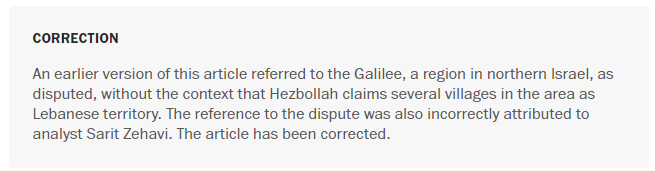 While the article has resolved the incorrect attribution to Zehavi, it is utterly appalling that The Washington Post states that baseless Hezbollah propaganda is the “context” that was missing when Loveday Morris decided to make the completely false claim that the Galilee region is “disputed.”
It’s simply not good enough.
The author is the Editorial Director of HonestReporting, a Jerusalem-based media watchdog with a focus on antisemitism and anti-Israel bias — where a version of this article first appeared.


