






Iran Covertly Developing Nuclear Warheads to Be Placed on Missiles, Dissident Group Reveals
Error: Contact form not found.

 by Corey Walker


Unidentified men carrying a model of Iran’s first-ever hypersonic missile, Fattah, past a mosque during a gathering to celebrate a failed Iranian attack on Israel, in Tehran, Iran, on April 15, 2024. Photo: Morteza Nikoubazl/NurPhoto via Reuters Connect
Iran has covertly ramped up efforts to construct nuclear warheads for solid-fuel missiles at two sites, a coalition of Iranian opposition groups revealed on Friday.
The National Council of Resistance of Iran (NCRI), which seeks to overthrow the country’s Islamist regime, unveiled a new report detailing how the nuclear warheads are intended for solid-fuel missiles with a 3,000-kilometer range and are being constructed at both the Shahrud and Semnan missile test sites in Iran. The initiatives are being spearheaded by the Organization for Advanced Defense Research (SPND), which is responsible for managing Iran’s nuclear weaponization efforts.
“Now, we have documented evidence showing that the missile sites in Shahrud and Semnan are fully coordinated with the regime’s nuclear weaponization body, SPND,” NCRI representative Soona Samsami said at a press conference discussing the group’s findings.
The report was sourced from the People’s Mojahedin Organization of Iran (PMOI/MEK), an Iranian dissident network.
According to the NCRI, the regime’s nuclear efforts are being furtively pursued under the guise of being part of a new “space initiative.”
While Shahrud has traditionally been used to develop and launch new rockets and satellites, the facility has been collaborating with the SPND to advance Iran’s nuclear ambitions, NCRI claimed. To bolster these efforts, SPND has allegedly deployed new personnel at the Shahrud missile test facility and “camouflaged” its efforts as a “satellite program” when, in reality, they are developing a satellite communication system to track the path of nuclear warheads. Iranian Revolutionary Guard Corps (IRGC) Brigadier General Ali Jafarabadi has helped develop the Ghaem-100 missile — the main nuclear warhead missile carrier — at the Shahrud site, NCRI said on Friday.

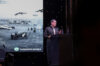
Alireza Jafarzadeh, deputy director of the National Council of Resistance of Iran (NCRI), discusses new report about Iranian nuclear efforts on Jan. 31, 2025 in Washington, DC. Photo: Screenshot
Moreover, the regime is reportedly constructing liquid-fuel missiles and nuclear warheads at a facility outside of the Iranian city of Semnan. The SPND has allegedly expanded the mostly underground facility for the stated purpose of “space operations.” The Semnan site currently houses eight complexes, up from two in 2005. A series of underground tunnels connects the complexes to each other, according to NCRI. The SPND Geophysics team — led by key experts Mohammad Javad Zaker, Hamed Aber, and Farhad Moradiani Khosrowabad — uses the Semnan site to conduct underground research regarding “high explosive detonations,” which NCRI claimed is “a key part in the development of nuclear weapons.”
Iran has gone to extensive lengths to hide its alleged nuclear proliferation ambitions and evade accountability from the international community, NCRI said on Friday, noting that SPND attempted to conceal Iran’s activities by creating the “Directorate for Nuclear Treaties,” an office which supposedly helps the regime stay in “compliance” with mandates imposed on its nuclear program. The office engages in negotiations with the United States and Europe to supposedly give updates and receive feedback on the nuclear program.
Iran has claimed that its nuclear program is for civilian purposes rather than building weapons. However, the UN’s nuclear watchdog, the International Atomic Energy Agency (IAEA), reported in December that Iran had greatly accelerated uranium enrichment to close to weapons grade at its Fordow site dug into a mountain. The UK, France, and Germany said in a statement that there is no “credible civilian justification” for Iran’s recent nuclear activity, arguing it “gives Iran the capability to rapidly produce sufficient fissile material for multiple nuclear weapons.”
NCRI argued, according to a confidential Iranian internal memo, that Tehran is “attempting to buy time through negotiating” with the United States and Europe to “maintain the current status quo to complete its nuclear weapons program.” According to the memo, the regime wants to prolong current negotiations for six months to circumvent United Nations Security Council Resolution 2231 — a 2015 resolution which outlines an inspection process for Iranian nuclear sites and establishes an end date for UN sanctions against Tehran.
US President Donald Trump, who withdrew from a 2015 deal with Iran that placed temporary restrictions on the Iranian nuclear program in exchange for lifting sanctions, has, along with several European countries, expressed interest in renegotiating a new nuclear agreement with the regime.
However, NCRI recommended that the international community reinstate previous UN sanctions against Iran that were lifted under the 2015 accord. Further, the group said that all Iranian nuclear sites should be closed and the IAEA should be given unfettered access to the facilities for inspection.


