


The Jewish Calendar: Sanctifying Time in a Fractured World
Error: Contact form not found.

 by Shuki Taylor

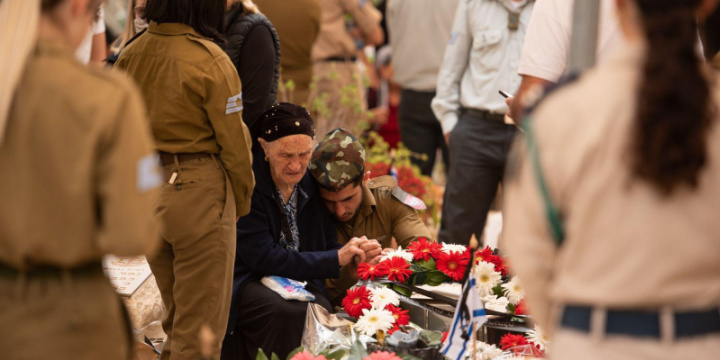
Mourners visit the graves of fallen IDF soldiers at Israel’s Yom HaZikaron ceremony. Photo: Israel Defense Forces
Time doesn’t always move the way we expect it to. Sometimes it blurs — with days stretching endlessly, their differences erased. Sometimes, everything happens at once, compressing joy and grief, memory and urgency, into a single, overwhelming present.
Since October 7, I’ve felt both: the loss of rhythm and the intensity of everything arriving at the same moment. I find myself forgetting what came before, uncertain how to prepare for what’s next. The rituals and holidays that once structured the year now land with surprising weight, or else pass almost unnoticed, leaving me searching for a sense of passage.
On November 24, 2023 — just before the release of the first hostages — Rabbi Oded Mazor penned a prayer:
In the days when each hour collides with the next
We have no choice but to cry and to laugh with the same eyes
To mourn and to dance at the same time
And the long arc of history is compressed into one day and one hour…
There is no order in this kind of time. Tears and laughter, mourning and music, are all pressed together. The calendar’s boxes are still there, but what fills them is unpredictable, and often too much to hold.
In the season of the Yamim — Yom HaShoah, Yom HaZikaron, and Yom HaAtzmaut — I’m especially aware of this disorientation. The rituals that are supposed to mark transitions often feel like thin threads pulled through chaos. When time is broken, how do we begin to heal?
Time as an Act of Freedom
While still slaves in Egypt, with no power over their own days or nights, the very first mitzvah ever given to the Jewish people was declaring the new month. God did not hand us a calendar to follow; God gave us the power and responsibility to shape it. Slaves do not own their time. The commandment to sanctify the new month was an act of spiritual agency — a way to say, “We may not control our circumstances, but we can shape our experience of them.” We built the rhythms and boundaries that give life meaning.
That same creative impulse lives in how we’ve shaped the modern calendar, and especially in the sequence of placing Yom HaZikaron directly before Yom HaAtzmaut. This structure was designed not to ease the emotional weight, but to heighten it. To insist that independence could not be celebrated without acknowledging its cost—and that mourning must give way to meaning.
The calendar was built to hold that intensity, and to transform it into something sacred. The emotional whiplash is real, but it is also honest. It says that celebration built on forgetfulness is empty, and that mourning cut off from hope is paralyzing. The calendar itself becomes a ritual, a choreography of the Jewish soul.
Time, Separation, and Sanctity
When time collapses or blurs, I find myself longing for boundaries. Not barriers, but passages that guide us. Judaism offers rituals of separation — like Havdalah at the end of Shabbat — as tools for transition. These rituals bless the space between sacred and ordinary.
This need for sanctity and distinction feels urgent in a time when so much has collapsed. Over the past year, we have seen people invent small rituals to push back against the blur. One I return to often is the Wings of Hope project.
In the summer of 2023, educator and mother Livnat Kutz invited children from her kibbutz, Kfar Aza, to help decorate a local bomb shelter. They gathered broken plastic toys, and — with creativity and vision — formed them into a pair of massive, colorful wings on the shelter wall.
It was a joyful, imaginative expression of freedom and hope. Then came October 7. Livnat, her husband Aviv, and their three children, Rotem, Yonatan, and Yiftach, were brutally murdered in their home. The family was gone — but the wings they built remained. Untouched. Unharmed.
Wings of Hope have been recreated around the world — as rituals of memory, healing, and longing for peace. At a recent M² seminar, educators wrote prayers on paper wings; in schools worldwide, children created “wings of blessing,” honoring lives and hostages. More than a memorial, Wings of Hope shows how Jewish time is marked through lived experience, and how our communities have embraced it as a powerful new ritual — one that expands tradition, sanctifies time, and gives deep emotions a form we can carry together.
Shaping Our Own Meaning Today
Jewish time is not only a record of what has happened. It is an imperative — an opportunity to participate, to shape the emotional and spiritual rhythms of the community. When the calendar feels out of sync, our challenge is not to surrender to the blur, but to to make each passage, however fragile, a place of meaning.
This year, as the Yamim return, let’s build them — out of memory, out of ritual, out of the full weight of what has been lost and what must still be hoped for. Because the calendar is not something that simply happens to us. It is something we are called, again and again, to create.
Shuki Taylor is the Founder & CEO of M2:The Institute for Experiential Jewish Education.