






Wall Street Journal vs. Wall Street Journal: A Paper at War With Its Own Reporting
Error: Contact form not found.

 by Rachel O'Donoghue


The Al Jazeera Media Network logo is seen on its headquarters building in Doha, Qatar, June 8, 2017. Photo: REUTERS/Naseem Zeitoon
Just over one year ago, HonestReporting highlighted a striking dichotomy within The Wall Street Journal — while its opinion pages often feature robust defenses of Israel and incisive commentary on the Middle East, its news coverage has charted an increasingly troubling course.
This isn’t simply about tone. It’s about fundamental inconsistencies within the Journal’s own reporting that reveal a creeping bias — contradictions that should concern anyone who values accurate journalism. To illustrate how far its news pages have drifted, consider two stories that bookend just over 12 months of WSJ coverage. Both involve Hamas and individuals with media credentials, but the difference in framing is stark.
When the Truth Was Told
In June 2024, the WSJ published a deeply reported feature, “The Hostages Next Door: Inside a Notable Gaza Family’s Dark Secret.”
It revealed how an outwardly respectable family — a doctor and a journalist who contributed to Al Jazeera — held three Israeli hostages captive in their Gaza apartment at the behest of Hamas.
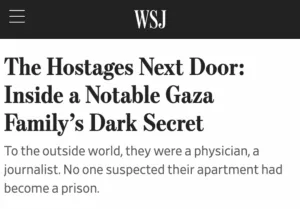
The Journal reported:
It was common knowledge in Nuseirat that the Al-Jamal family was close to Hamas, according to local residents who spoke to The Wall Street Journal. But they said few people… knew of the secret locked in the small, darkened room in the family’s apartment.
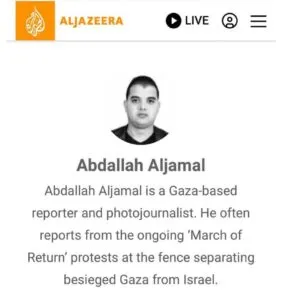
The hostages and Israeli security forces have said their captors included Al-Jamal’s son, 37-year-old Palestinian journalist Abdullah Al-Jamal.
From their locked room, the hostages could hear Abdullah — a Hamas operative moonlighting as a “journalist” — going about his daily life with his family.
This echoed what HonestReporting had already exposed months earlier: numerous Gaza-based “journalists” were not neutral observers but active participants in Hamas’ terror machine, including the October 7 massacre.
Although the WSJ didn’t note it, Al Jazeera publicly denied any link to Abdullah Al-Jamal — even as he appeared on their website, complete with byline and photograph. That denial, later proven false, is part of a consistent pattern: Al Jazeera repeatedly distances itself from individuals later exposed as active Hamas operatives.
When the Truth Was Buried
Fast forward to August 2025. The WSJ covered an IDF strike that killed four Al Jazeera journalists, including Anas Al-Sharif. The headline reads: “Israel Killed Four Al Jazeera Journalists in Airstrike, Network Says.”
The subhead: “Israel accuses Anas Al-Sharif, one of Gaza’s most prominent journalists, of heading Hamas cell, allegations his network denies.”
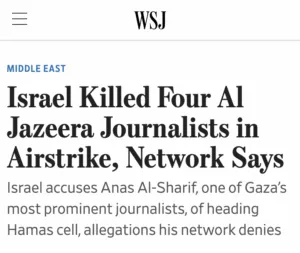
Notice the shift: The headline’s focus is that Israel “killed journalists,” filtered explicitly through Al Jazeera’s lens. Israel’s evidence-backed claim that Al-Sharif commanded a Hamas cell is demoted to a subordinate clause and hedged with “allegations his network denies.”
Where the June 2024 piece treated Hamas’ exploitation of journalistic cover as fact, the 2025 piece presents it as a contested claim — even though the WSJ’s own reporting has already documented this exact Hamas tactic. The failure to apply its own prior context is not just sloppy; it undermines reader trust.
Why This Matters — and How to Stop the Drift
This isn’t nitpicking. Headlines shape reader perceptions far more than buried paragraphs. When Israel’s claims are framed as dubious while Hamas-linked outlets’ denials are given equal weight, the result is distortion.
Bias doesn’t always announce itself with screaming editorials. Often, it creeps in through headline framing, asymmetric skepticism, and a refusal to connect the dots the paper has already laid out.
The solution is simple: consistency. If the WSJ has the courage to expose Hamas’ use of “journalists” when reporting on hostage rescues, it should apply the same factual clarity when reporting on IDF strikes against Hamas operatives with press credentials. Evidence should not be treated as a mere “allegation” when its own prior work substantiates the pattern.
What Can Readers Do?
Calling this out matters. Letters to the editor are one avenue, but they aren’t enough on their own. Large outlets like the WSJ take notice when:
- Readers demand accountability publicly: Share clear examples of the contradictions (like the two pieces above) on social platforms, tagging the reporters and editors.
- Subscribers vote with their wallets: If you’re a WSJ subscriber, tell them directly that you will reconsider your subscription if their news reporting continues to contradict their own documented facts.
- Advertisers hear about it: Major outlets pay attention when their advertisers are contacted with concerns about inconsistent or misleading reporting.
Public pressure works best when it highlights specific failures with receipts — the June 2024 and August 2025 pieces are a textbook example.
The Wall Street Journal is capable of excellent journalism. But until its news desk aligns with its own facts rather than undermining them, its credibility will remain in question.
The author is a contributor to HonestReporting, a Jerusalem-based media watchdog with a focus on antisemitism and anti-Israel bias — where a version of this article first appeared.


