





How to Improve and Build US-Israel Ties for the Long-Term
Error: Contact form not found.
 by Samuel J. Abrams

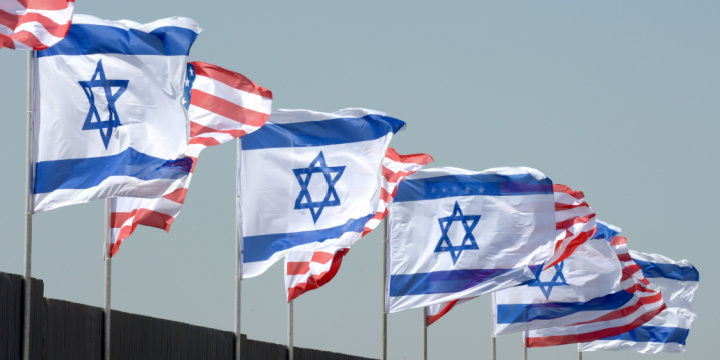
Israeli and American flags displayed at Ben Gurion Airport in March 2013. Photo: Moshe Milner / GPO
The current war with Iran, sparked by US-backed Israeli strikes on Iranian nuclear and military sites, will have consequences far beyond the battlefield. Most of the commentary so far has focused on the military and economic effects. But wars also shift public opinion, and those shifts often outlast the fighting.
In the United States, the war has already followed a familiar arc. It began with hesitation, and has grown less popular as the prospect of a quick resolution has receded. But the war itself is not the only thing Americans are judging. So are the figures, and the countries, associated with it.
At the center of that association is President Donald Trump. Standing next to him, fairly or not, is the State of Israel.
Commentators can debate whether Trump or Prime Minister Benjamin Netanyahu bears more responsibility for the war, but the public is not sorting them apart. For many Americans, Israel is simply part of the same political and moral frame through which they size up Trump himself.
That matters now more than it would have a decade ago. Favorability toward Israel among Americans has fallen sharply and is at or near record lows in multiple surveys. The slide did not start with this war. It accelerated after October 7, 2023, but the longer trend line, especially among younger Americans, has been downward for years.
It is hard to overstate the contrast with an earlier era. Mid-20th-century America treated Israel as a sympathetic young democracy, built in the shadow of the Holocaust. Leon Uris’s “Exodus,” published in 1958, sat on the New York Times bestseller list for almost two years and shaped how a generation of American readers understood the country. That story has lost much of its grip, displaced by narratives that are often far less sympathetic.
The present war is likely to accelerate that shift. Trump’s approval ratings are likely to erode as the fighting drags on, and polling data suggests Israel’s standing in American public opinion is likely to erode with them, not so much because of what Israel does, but because of whom it is seen as standing next to.
Survey data from last fall make the link hard to miss. The Yale Youth Poll (N = 3,426, with an oversample of younger adults that was adjusted by statistical weighting) shows a tight relationship between what Americans think of Trump and what they think of Israel.
Asked how they felt about Trump’s job performance, 47 percent of respondents strongly disapproved and 23 percent strongly approved. Across that split, attitudes toward Israel look very different.
Thirty-four percent of strong Trump disapprovers reject the idea that Israel should exist as a Jewish state. Among strong approvers, only 11 percent do. On US military aid to Israel, 61 percent of strong disapprovers want to see it cut or ended, against just 21 percent of strong approvers. Those are three-to-one gaps.
The same split appears in how respondents define Zionism itself. Strong Trump disapprovers are three times more likely than strong approvers to say Zionism means “establishing and maintaining a Jewish demographic majority in Palestine by driving out the native Palestinian population” (25 percent versus 7 percent), and almost four times more likely to describe it as “a form of racism and apartheid against Palestinians” (23 percent versus 6 percent).
Some of this, of course, reflects the familiar liberal-conservative split. Liberals are consistently more anti-Israel than conservatives on every measure studied. On military aid alone, 68 percent of liberals want to see it cut, compared with 28 percent of conservatives.
But ideology does not explain the whole story. The Trump effect shows up even inside the conservative camp. Take the question of whether Israel should exist as a Jewish state. Among self-identified conservatives, those who strongly disapprove of Trump are more than twice as likely as those who strongly approve of him to reject that proposition: 24 percent to 10 percent. The same pattern holds on all four of the indicators examined, and it survives weighting the sample to national adult benchmarks. Even among conservatives, who are the most pro-Israel segment of the electorate, the more a person disapproves of Trump, the less pro-Israel they are. Trump attitudes, in other words, are not just standing in for ideology. They are an independent axis of how Americans are thinking about Israel.
That has real consequences. If Trump’s political fortunes decline, as presidents’ fortunes often do during a long war, Israel’s public standing may well slide with them. Not because Americans will have reconsidered Israel’s policies on the merits, but because they will have gotten used to seeing Israel as part of the broader Trump story.
For Israel, this is a real strategic problem. It has long enjoyed broad bipartisan backing in the United States. That consensus was already fraying before Trump came back to the White House, and today it is less a consensus than a partisan marker.
For American Jews, the bind is especially acute. American Jews, Orthodox Jews aside, remain one of the most pro-Israel and also one of the most anti-Trump constituencies in the country. Holding both of those commitments at the same time is no longer a theoretical exercise. It shows up at the Shabbat table, in the synagogue, in the Federation board meeting, in the college dorm.
At the individual level, it creates an uncomfortable dissonance: how do you square deep support for Israel with deep opposition to the president most publicly associated with it? At the communal level, it widens fractures that were already there. Debates about Israel that used to rest on common ground are increasingly getting swallowed by American partisan fights, and families, synagogues, and Jewish organizations are finding themselves navigating arguments that feel less political than existential.
The real risk is not disagreement; rather it is distortion. When Israel is seen mainly through the filter of Trump, the debate stops being about Israel, about its policies, its constraints, its dilemmas, and becomes a proxy for where you sit in American politics. That is bad for honest argument and worse for the underlying relationship.
The US-Israel relationship is too consequential to be run through the fortunes of one politician, however sympathetic to Israel he may be. And for American Jews, the task is more specific: to build and maintain a case for Israel that is coherent on its own terms, independent of whoever happens to be in the Oval Office, and capable of surviving polarization rather than simply mirroring it.
Wars reshape more than borders. Whether Israel comes out of this one as a broadly supported ally or as a partisan symbol will not be decided solely on the battlefield. It will be decided by whether Americans can separate what they think of Israel from what they think of Donald Trump.
Samuel J. Abrams is a professor of politics at Sarah Lawrence College and a senior fellow at the American Enterprise Institute.


