I Found an Elie Wiesel Speech From 30 Years Ago; You Must Read It
Error: Contact form not found.

 by Mordechai I. Twersky

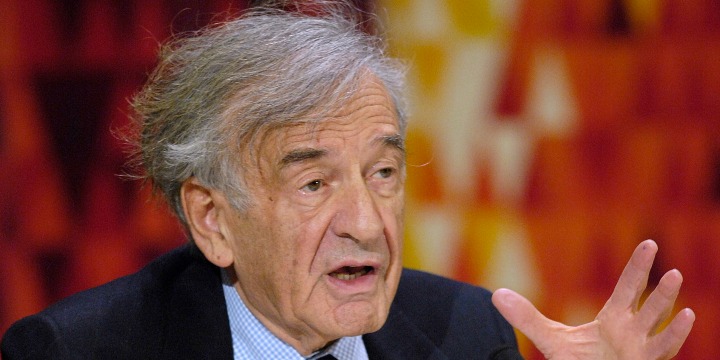
Late Holocaust survivor and Nobel Laureate Elie Wiesel speaks about a report he helped prepare discussing the situation in North Korea at the United Nations in New York, Nov. 16, 2006. Photo: Reuters / Chip East / File.
Last week, I went back and listened to a 1992 commencement address by Elie Wiesel.
I had attended the ceremony as a reporter, and later aired the speech in full on a radio program I produced in New York. The recording has sat, for years, among hundreds of others in my archive.
The timing of revisiting it now was difficult to ignore.
The address was delivered on Jan. 30, 1992, at Hunter College — just five months after the Crown Heights riots, which followed a fatal accident involving a Hasidic motorcade and erupted into days of anti-Jewish violence in Brooklyn. The city was still unsettled.
Wiesel was not speaking in calm retrospect. He was speaking into that moment.
He began by speaking to the graduates about education and moral responsibility. “What I receive, I must pass on to others,” he said. “The knowledge that I have acquired must not remain imprisoned in my own brain, nor even in my own life.”
But the speech quickly became something more urgent.
“Education must negate intolerance, must oppose fanaticism,” he warned.
Then he defined fanaticism with striking precision: “Literature and fanaticism do not go together. Culture and fanaticism are forever irreconcilable. For the fanatic is against culture. The fanatic is against culture because culture means freedom of Spirit, freedom of imagination, and the fanatic fears someone else’s imagination, just as the fanatic fears someone else’s freedom.”
Wiesel understood fanaticism not simply as hatred, but as fear — fear of difference, fear of thought, fear of freedom itself.
“In fact,” he continued, “the fanatic who wishes to inspire fear is ultimately doomed to live in fear, always, fear of the stranger, fear of the other, fear of the other inside him or her.”
He described fanaticism as having “many faces and many origins”: “racial fanaticism, religious bigotry, ethnic hatred, cultural intolerance.”
And then came the line that feels especially difficult to hear today: “What they all have in common is an urge to replace words with violence, reason with blind impulse, hope with terror.”
This was 1992 — before social media, before smartphones, before algorithms could supercharge grievance and demagoguery to millions in real time.
Yet Wiesel’s warning was already unmistakable.
“For a while, my generation could have believed that fanaticism was on its decline. It isn’t. Quite the contrary. It is on the rise.”
He spoke of “old clichés, senseless archetypes and absurd accusations” being used to justify hatred. He spoke of a city that “has never seemed as divided, nor as threatened.”
And then, more personally: “As a Jew, I have witnessed the consequences of antisemitism, which is the oldest group prejudice in history. We Jews have been accused of many sins. Now we are perceived … as the group that wields more power than any other.”
He pushed back in plain terms: “Have they ever heard of poor Jews who are unable to make ends meet…? All collective judgments about any group I believe are wrong. Only racists make such judgments, and racism is stupid, just as it is ugly.”
There was nothing abstract about his words. They were rooted in what he had seen — in history, and in the city around him.
“Fanaticism leads to hatred,” he said, “and hatred is both self-destructive and destructive.”
He also spoke of “yesterday’s demons,” of strangers being met “with animosity almost everywhere,” and asked the graduates a question that feels no less urgent now: “And who isn’t a stranger to someone?”
Wiesel was not speaking as a prophet. He was speaking as a witness.
He had seen what happens when societies surrender reason to impulse, when scapegoats replace complexity, when demagogues teach people to fear the unfamiliar and blame the vulnerable.
That is what makes this old recording so difficult to dismiss as merely historical.
Its power lies not in prediction, but in recognition.
Listening now, what is striking is not simply Wiesel’s moral clarity. It is how clearly he understood that fanaticism would adapt, persist, and reassert itself wherever fear proved more seductive than thought.
The recording ends with words that, in 1992, were directed at one graduating class in one troubled city: “I speak to you … as a witness. I speak to you because I do not want my past to become your future.”
The recording ends.
More than three decades later, the voice feels less like an artifact than a warning still waiting to be fully heard.
Mordechai I. Twersky is a veteran multimedia journalist and essayist.