










US, Israel Said to Plan New Iran Strikes as Tehran Pounds UAE
Error: Contact form not found.

 by Debbie Weiss

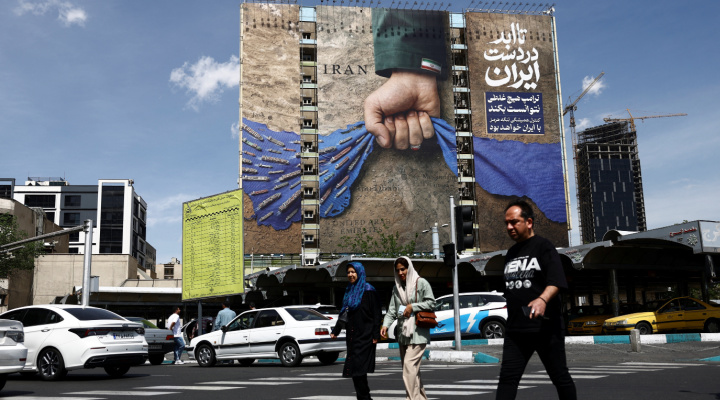
People walk past a billboard with a graphic design about the Strait of Hormuz on a building, amid a ceasefire between US and Iran, in Tehran, Iran, April 27, 2026. Photo: Majid Asgaripour/WANA (West Asia News Agency) via REUTERS
Israel and the US are coordinating plans for another round of strikes on Iranian targets, CNN reported Tuesday, as Iran kept up its attacks on the United Arab Emirates for a second straight day and amid reports that the Gulf state’s defense increasingly appeared to be drawing on Israeli support.
CNN cited an Israeli source as saying that the plans, largely drawn up before the ceasefire with Iran began in April, include strikes on Iran’s energy infrastructure and targeted killings of senior officials.
“The intention would be to carry out a short campaign aimed at pressuring Iran into further concessions in negotiations,” the source said, adding that any decision to resume the war would be made by US President Donald Trump.
CNN also reported that an Israeli-operated Iron Dome battery intercepted an Iranian missile over the UAE on Monday, the first known use of the system to defend a Gulf state. The system had been secretly deployed there at the start of the war, according to the report, along with Israel Defense Forces (IDF) soldiers sent to operate the system.
The system has so far intercepted dozens of Iranian missiles in the UAE, according to Israeli officials cited in a separate report by Axios.
The UAE said Iran fired 12 ballistic missiles, three cruise missiles, and four drones at the country on Monday. And then, according to Emirati officials, Iran launched additional missiles and drones on Tuesday. The UAE’s Foreign Ministry called the attacks a “serious escalation” and a “direct threat” to national security, adding that the UAE reserves its “full and legitimate right” to respond.
Another report by the London-based Iran International said that Iranian President Masoud Pezeshkian was furious over the escalation and warned military commanders of the regime’s Islamic Revolutionary Guard Corps (IRGC) that the “completely irresponsible” attacks risked dragging Iran back into full-scale war.
He also described the IRGC’s handling of tensions with regional states as “madness,” the report said, citing sources close to the matter, and warned that the consequences could be irreversible.
The New York Times reported last week that senior IRGC commanders were increasingly driving decision-making in Tehran, with Iran’s new supreme leader, Ayatollah Mojtaba Khamenei, unable to command the system with the authority once wielded by his father. The report added to mounting rumors over Khamenei’s health and capacity, and to growing confusion over who is ultimately directing Iran’s military and political response.
Iranian state media, citing an unnamed military official, said that the strikes on the UAE were unintentional and “the result of the US military’s adventurism to create passage for illegal ship transit” through the Strait of Hormuz, a narrow waterway between the Persian Gulf and the Gulf of Oman through which about one-fifth of the world’s trade in oil and liquefied natural gas flows.
Adm. Brad Cooper, the head of US Central Command, on Monday said American forces had cleared a mine-free route through the strait, which Iran shut in response to the US-Israeli strikes, and were escorting civilian vessels when Tehran launched cruise missiles, drones, and small boats at ships under US protection.
US military helicopters destroyed six of the boats, Cooper told reporters, saying “each and every” threat had been defeated.
Beyond mounting escorted transits for commercial vessels, the US has countered Iran’s shutdown of the waterway by blockading Iranian ports, a move that has further crippled the country’s already ailing economy and pushed it to the brink of collapse.
Iran’s Revolutionary Guards issued a new warning Tuesday, saying any vessel that does not use the route approved by Tehran through the Strait of Hormuz would face retaliation.
“We warn all vessels planning to transit the Strait of Hormuz that the only safe passage is the corridor previously announced by Iran. Any diversion of ships to other routes is dangerous and will result in a firm response from the Iranian Revolutionary Guards navy,” the Guards said in a statement carried by state television.
IDF Chief of Staff Lt. Gen. Eyal Zamir on Tuesday said the military was “closely monitoring developments in the Gulf” and is “prepared to respond with force against any attempt to harm Israel.”


