









Azerbaijani Jewish Leaders Urge Israel to Halt Armenian Genocide Bill Amid Fears of Strained Baku-Jerusalem Ties
Error: Contact form not found.

 by Ailin Vilches Arguello

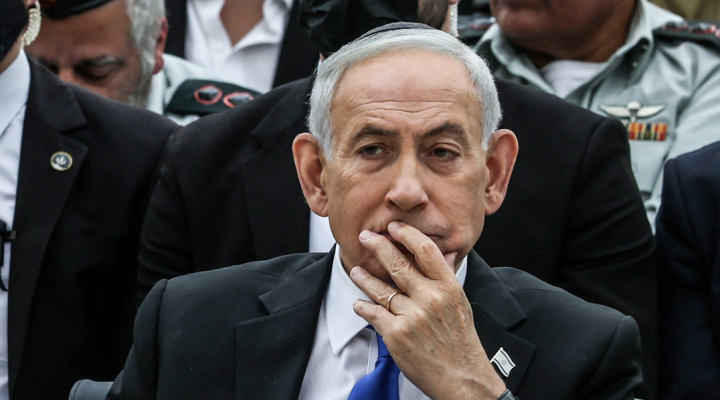
Israel’s Prime Minister Benjamin Netanyahu attends a ceremony commemorating Israel’s Remembrance Day for fallen soldiers, or Yom HaZikaron, at the Military Cemetery on Mount Herzl in Jerusalem, April 21, 2026. Photo: ILIA YEFIMOVICH/Pool via REUTERS
Azerbaijani Jewish Leaders Urge Israel to Reject Armenian Genocide Recognition, Citing Risk to Ties
Leaders of Azerbaijan’s three main Jewish communities have urged Israeli lawmakers to reject legislation recognizing the Armenian Genocide, warning that the move could seriously strain ties with Baku and jeopardize a key strategic regional partnership.
In a joint letter sent to Knesset members, Milikh Yevdayev, president of the Mountain Jewish community, Alexander Sharovsky, head of the Ashkenazi Jewish community, and Rabbi Zamir Isayev, leader of the Sephardic community, argued that complex historical questions should not be decided through political processes or become matters of state policy. They warned the proposal could erode trust between Jerusalem and Baku, cautioning that sensitive historical issues risk becoming diplomatic flashpoints if addressed through legislation rather than scholarship.
Azerbaijani officials have already denounced the move, arguing that formal recognition of the Armenian Genocide could damage relations between the two countries and calling on lawmakers to withdraw the proposal.
Amid a sharp deterioration in relations with Turkey, Israel formally recognized the 1915 Armenian Genocide for the first time last week. Ankara has repeatedly rejected claims that the mass killings during the final years of World War I constitute genocide, while accusing Israel of committing “genocide” in Gaza. Turkey acknowledges that large numbers of Armenians were killed in clashes with government forces in the Ottoman Empire during WWI, but it disputes the figures and has long rejected claims that the killings were systematically planned.
Azerbaijan has repeatedly aligned itself with Turkey’s stance on the issue, particularly in light of its longstanding conflict with neighboring Armenia. “The distortion of the historical facts surrounding the events of 1915, and the reduction of a complex historical issue to a political decision without a sound legal or scholarly basis, are unacceptable,” Baku’s Foreign Ministry said in a statement last week. It added that such actions do not contribute to reconciliation, and instead deepen divisions and undermine regional stability.
The Israeli Cabinet unanimously approved the recognition proposal, which is now expected to be ratified by parliament before taking effect. Israeli Foreign Minister Gideon Saar praised the move as a long-overdue step, writing in a post on X that “it’s never too late to do the right thing.” He added that Israel had joined 32 countries in fulfilling what he called a moral duty to recognize the historical truth and reject attempts to deny it.
Azerbaijan’s ties with Israel have long been significant, with the country serving as the Jewish state’s most vital ally in the Caucasus and Central Asia for more than three decades, fostering a partnership spanning energy security, defense and intelligence. Sharing a lengthy border with Iran while maintaining strong ties with both Israel and Turkey, the predominantly Shi’ite Muslim nation holds a unique strategic advantage that could challenge Tehran’s regional influence.
“Azerbaijan plays a unique role in Israel’s broader strategy by serving as a potential bridge for normalizing relations between the Jewish State and other Muslim-majority countries,” Rabbi Marc Schneier, president of the Foundation for Ethnic Understanding, told The Algemeiner in an exclusive interview last year.
Baku’s strategic importance stems not only from its position at the crossroads of a growing pro-Western bloc countering Iran’s regional ambitions, but also from its economic weight in the region. Azerbaijan and Israel have continued to expand cooperation, particularly in the energy sector, underscoring Baku’s emerging role as a strategic player in the shifting Middle East.


