


Former US Defense Official Says Obama’s Iran Deal Will ‘Bring Disequilibrium to the Middle East’
Error: Contact form not found.

 by Eliezer Sherman

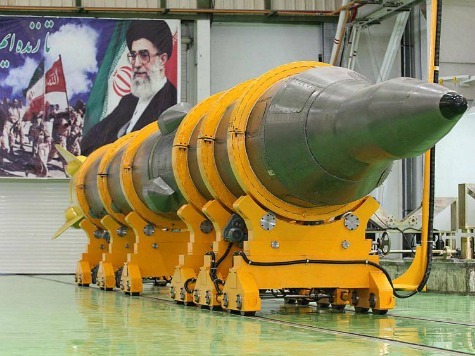
An Iranian missile in front of a portrait of the Islamic Republic’s Supreme Leader. Russia is ready to give Iran missiles if UN sanctions are lifted, an expert said. Photo: Iranian Government.
The nuclear deal pursued by the Obama administration will bring “dis-equilibrium to the Middle East,” a senior research fellow at the Hudson Institute and former U.S. defense official told the House Committee on Foreign Affairs on Tuesday.
Doran said the Obama administration’s pursuit of the deal has convinced the U.S.’s traditional Middle East allies that the U.S. has backed off from its role as a regional “security guarantor.”
Speaking during a hearing examining the consequences of a nuclear deal, Doran noted Israeli Prime Minister Benjamin Netanyahu’s “uniquely vocal” warning against signing a bad deal with Iran. He said Gulf countries were showing more restraint publicly, but privately were stepping up efforts to confront Iran, such as the recent Saudi-led offensive against Iranian-backed Houti rebels in Yemen.
Kenneth Pollack, a senior research fellow at the Brookings Institute, said many in the region may perceive the U.S.’s deal with Iran as a “get out of Middle East card.”
He said the default response by Gulf countries is to “get in Iran’s face,” such as has been shown by the Yemen campaign. Still, Pollack warned that Gulf countries may not possess the logistical know-how or military might to confront Iran while simultaneously maintaining stability in their own countries.
Dr. Michael Makovsky, the CEO of JISNA, warned against the arms race the nuclear deal would set off in the region, which could ultimately lead to a Middle East “nuclear contagion.”
“We don’t want the Saudis to have nuclear weapons,” he said, adding that the ramifications of a military strike against Iran’s nuclear sites would be far more containable than a nuclear arms race “and a really serious conflict involving nuclear powers.”


