










The War for the Sea Routes: The Lesson from the Hormuz Crisis
Error: Contact form not found.

 by Sagiv Steinberg

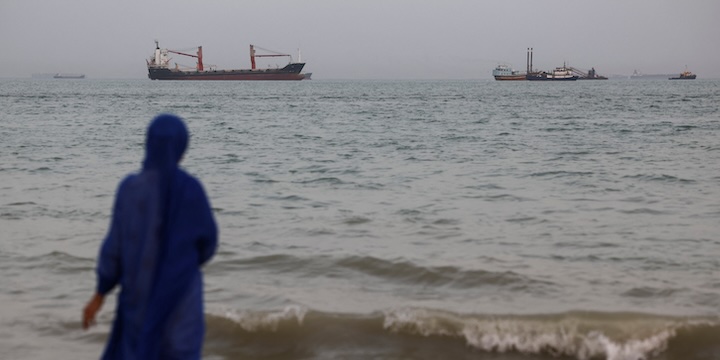
Vessels in the Strait of Hormuz are visible near the beach of Bandar Abbas, Iran, May 22, 2026. Photo: Majid Asgaripour/WANA (West Asia News Agency) via REUTERS
For decades, the West has treated the world’s oceans as an open domain governed by universal norms emphasizing freedom of navigation. This principle underpinned global commerce and economic stability.
Yet, actions by Iran and the Houthis in Yemen have fundamentally challenged this assumption. What used to be categorized as sporadic piracy has now emerged as a strategic tool of modern warfare, deployed with surprising effectiveness that caught many Western analysts off guard.
The planet’s major strategic straits represent critical chokepoints whose control or disruption can sway the course of global trade, energy security, and geopolitical power balances.
Prominent among them are the Strait of Hormuz, Bab el-Mandeb, Suez Canal, Strait of Malacca, Panama Canal, Bosporus, Strait of Gibraltar, Bering Strait, and Danish Straits. These waterways have evolved from neutral passages into contested battlegrounds of economic warfare. Here, radical regimes and determined regional actors seek to override international maritime conventions with methods of political blackmail and extortion.
Iran’s strategy of utilizing its geographic advantages in these areas to extract “protection fees” and broadcast threats transcends simple confrontation with adversaries. It is part of a calculated effort to establish precedents that weaken the post-World War II liberal international order. By turning vital sea routes into venues for imposed tolls or bargaining chips, Iran is effectively declaring war on the open maritime system that has facilitated prosperity worldwide.
This “war of the straits” signifies an innovative theater in contemporary international relations. The 20th century was dominated by conventional land wars featuring tanks and massed infantry. In contrast, the 21st century features hybrid approaches: cost-effective drones and missiles combined with resurrected low-technology strategies, including maritime sieges and even basic physical barriers like those seen in regional conflicts. The recent crises in the Suez Canal stand out as particularly instructive, paralleling developments in Hormuz and exposing systemic weaknesses in worldwide logistics.
The Suez Canal, a narrow but essential artery for global shipping, illustrates the dangers when such passages become pawns in regional power plays or targets for non-state actors like the Houthis. Disruptions here have cascading effects on supply chains, inflating costs, delaying deliveries, and demonstrating how geography itself can serve as a weapon to inflict economic pain on the West or to gain leverage in diplomatic negotiations.
Adding to these pressures is Turkey’s strategic posture. Promoting the “Blue Homeland” (Mavi Vatan) concept, Turkey has expanded its maritime claims in the Mediterranean, Aegean, and Black Sea regions. Equipped with a formidable naval force, it actively seeks to redraw the map of influence in the eastern Mediterranean. Through its oversight of the Bosporus and Dardanelles, Ankara can influence or restrict maritime movements, leveraging the Montreux Convention to control warship transits, as evidenced by measures affecting Russian vessels.
Turkey recognizes the pivotal role of sea route control in achieving regional hegemony. Its pursuits in the Mediterranean, encompassing disputes over energy resources, exclusive economic zones, and boundary demarcations, have escalated frictions with Greece and Cyprus. This has placed additional strain on NATO, forcing the alliance to manage an ally with an increasingly autonomous and aggressive naval policy. Such dynamics highlight how aspiring powers aim to dismantle Western maritime hegemony and assert alternative visions, with Turkey exemplifying this shift by capitalizing on its straits position.
China’s approach further intensifies this global contest. The “Malacca Dilemma” – vulnerability to disruptions in key Southeast Asian waterways – drives much of Beijing’s foreign and defense policy. To counter this Achilles’ heel in its energy and commodity imports, China has invested heavily in a string of ports across the Indian Ocean, expanded the Belt and Road Initiative for terrestrial connectivity to circumvent sea dependencies, and investigated emerging Arctic shipping lanes opened by melting ice.
In doing so, China constructs a more autonomous supply network resistant to potential blockades. This stands in stark opposition to US-led initiatives focused on preserving freedom of navigation operations. The rivalry is not solely about military hardware but fundamentally about mastering maritime geography and logistics resilience.
Looking forward, the battle for energy security and trade continuity will be decided by effective control over these chokepoints or successful diversification strategies. As China advances its risk-mitigation plans, Western nations are compelled to defend a system facing multifaceted threats from revisionist powers and local disruptors who treat straits as strategic assets.
Israel must draw critical lessons from these trends. National security cannot remain confined to terrestrial defenses alone. Israel’s prosperity relies heavily on secure maritime corridors linking the Mediterranean to the Red Sea. Facing Iranian-backed disruptions near Bab el-Mandeb and Turkey’s growing naval footprint, Jerusalem requires an enhanced maritime strategy. This involves not just safeguarding navigation rights but ensuring the seas remain conduits for free trade, immune to coercive tactics.
In the coming years, conflicts may shift toward indirect methods: disrupting enemy economies via trade route manipulation rather than kinetic engagements over cities. The straits emerge as primary arenas where influence determines outcomes. Entities lacking physical, technological, or diplomatic presence in these zones may find themselves sidelined in an era where command of movement confers decisive advantage.
The Hormuz Crisis and parallel events underscore a pivotal truth: the maritime commons are no longer immune to great power competition. For the West and partners including Israel, swift adaptation to this evolving landscape is imperative to sustain global stability and economic vitality.
Sagiv Steinberg is a Middle East geostrategic analyst and communications expert. He previously served as a senior editor in Israeli and international media organizations and he is the Communications Manager of the Jerusalem Center for Security and Foreign Affairs (JCFA), a leading Israeli think tank.


