





Antisemitic Trends in Poland
Error: Contact form not found.

 by Maggie Glanowska

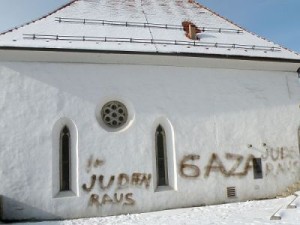
Synagogue vandalized by Anti-Semitic slogans. Photo: Untamle.
In Poland, anti-Semitism is still one of the most controversial, sensitive and shameful subjects in the political, cultural and socio-economic arenas. To better understand the current sentiment Poles share and have a clearer picture of the Polish-Jewish relationship, I have created a study that determines that there is no direct correlation between the state of the economy in modern Poland and anti-Semitism between 1993 and 2010. My dependent variable constituted years in which anti-Semitism was high in relation to other years, while my independent variables were composed of the four most common economic indicators used to measure economic performance: unemployment rate, inflation rate, consumer price index and gross domestic product (GDP). Surprisingly, when I compared the levels of anti-Semitism with the economic indicators, the results were clear – no correlation. For instance, when I compared the data of 2006, all four variables were desirable, the state of the economy was not deteriorating, but the level of anti-Semitism continued to be high. The results were pretty consistent with an exception of 1993.
Since the state of economy has a limited or almost non-existent influence on anti-Semitism in contemporary Poland, the question is: What triggers such strong anti-Semitic moods in Poland? I believe the answer can be found in Polish nationalism. Nationalism, as a collective state of mind, creates ethno-centric perception of reality and provides basis for prejudice and hate. Anti-Semitism is infused by political agendas of extremist right-wing parties that are in power since the fall of communism. Taking into consideration the tragic history of the country and deeply rooted nationalism, Poles do not oppose. Political parties, supported by the influential Catholic Church, create an environment in which anti-Semitism is cultivated. Adam Michnik, former Solidarity activist, in his article The Polish Witch-Hunt published on June 28, 2007, stated, “Today, Poland is ruled by a coalition of three parties: post-Solidarity revanchists of the Law and Justice party; post-Communist provincial trouble-makers of the Self-Defense Party; and the heirs of pre-World War II chauvinist, xenophobic, and anti-Semitic groups that form the League of Polish Families.” This “grand coalition” of the political parties and the Church lost its true concept and threshold between healthy patriotism and unhealthy nationalism.
Modern nationalistic spirit of Poles is also a response to the process of globalization and Poland’s entrance into the European Union. The melting pot of cultures, political agendas and religions creates uncomfortable fear and generates identity crises for Poles. Tragic historical events that took place in Poland, the fear of change and possible cultural invasion create opportunity for neo-nationalistic and anti-Semitic movements. The threat is imaginary, but the fear may be real, so Poles resist an idea of a multi-ethnic country. Therefore, anti-Semitism is a response of Poles to historical struggles for independence, political instability and insecure national identity, which of course cannot, is not, and should not be treated as a legitimate justification.


