




How Latin America’s Political Realignment Is Shaping Israel’s Future
Error: Contact form not found.

 by Leah Soibel

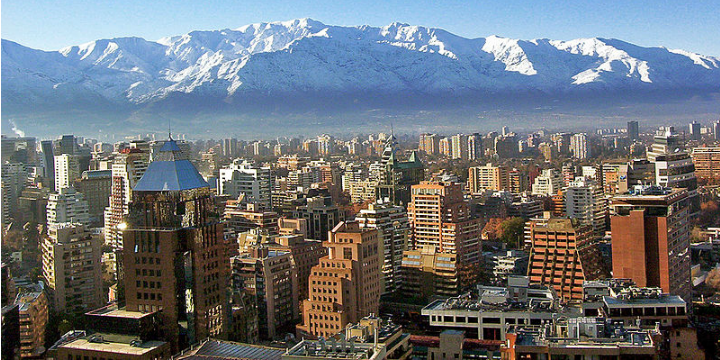
The Chilean capital of Santiago. Photo: Victor San Martin.
Colombia’s president, Gustavo Petro, was on brand when he recently posted “Heil Hitler” in response to an article he disagreed with and, days later at the UN Security Council, compared Israel to Nazi Germany. Long before he severed relations with Israel over the Gaza war, Petro had made similar comparisons. He was hardly alone. For years, far-left Latin American leaders have treated hostility toward Israel as both an ideological reflex and shorthand for opposition to the West. Yet as Petro nears the end of his presidency, the politics he represents may be giving way to a new era across Latin America.
The Isaac Accords point toward that future.
The initiative’s name evokes the Abraham Accords, agreements that normalized relations between Israel and several Arab and Muslim-majority states beginning in 2020. Those relationships have weathered the Gaza war and Israel’s confrontation with Iran. The Isaac Accords aim to emulate that success in Latin America.
Argentina’s President Javier Milei and Israeli Prime Minister Benjamin Netanyahu signed the Isaac Accords in April, less than a year after the initiative was launched. In that time, Milei broadened economic ties with Israel, strengthened security and counterterrorism coordination, and designated Iran’s Islamic Revolutionary Guard Corps a terrorist organization.
Several other Latin American countries have followed Milei’s lead.
Paraguay, Ecuador and Costa Rica have designated the IRGC, Hezbollah and Hamas as terrorist organizations. Ecuador has opened an office in Jerusalem with diplomatic status. Costa Rica is planning a similar move, has signed a free trade agreement with Israel, and formally endorsed the International Holocaust Remembrance Alliance definition of antisemitism.
The initiatives come amid a sweeping shift in political direction across parts of the region, as nearly two decades of leftist governments often hostile to Israel have yielded to a new generation of right-leaning leaders.
Chile, home to the largest Palestinian population outside the Middle East, elected a new president in March. José Antonio Kast has already met with Israeli President Isaac Herzog and appointed a new ambassador, filling a post left vacant after his predecessor recalled the envoy just weeks after the Oct. 7, 2023, Hamas attack.
Bolivia, which for years had aligned closely with Iran and been among Israel’s most vocal critics, restored diplomatic relations in December shortly after President Rodrigo Paz took office.
As anti-Israel sentiment grows across both the left and the right in Western democracies, the case for strengthening alliances elsewhere has grown more urgent.
While Latin America is a vast region home to about 650 million people, it may have more in common with Israel than meets the eye. Both are diverse, resilient societies that have learned to adapt in unpredictable environments. Latin American countries face serious security concerns and the challenge of modernizing their economies. Israel, small in scale but with outsized capabilities, offers expertise and technologies refined under some of the most demanding conditions imaginable. Together, those strengths create new possibilities in trade, innovation and diplomacy that could benefit millions across both regions.
The United States also stands to gain by reinforcing alliances while curbing the influence of adversaries already active across the region.
Russia seeks strategic footholds near the United States, while China pursues access to resources and markets. But Iran is widely viewed as the principal regional threat, anchored in Venezuela and the tri-border area where Brazil, Argentina and Paraguay converge. Its proxy Hezbollah has long been linked to drug trafficking, weapons smuggling and money laundering across the continent, as well as surveillance and other operations on Iran’s behalf. The most notorious was the 1994 bombing of the AMIA Jewish community center in Buenos Aires, which killed 85 people and remains the deadliest terrorist attack in Latin American history.
Much of their campaign plays out through Spanish-language media.
HispanTV, Iran’s 24/7 Spanish-language network, engages a wide audience in Latin America and parts of the United States. State-linked outlets with similar messaging, including RT en Español and Al Jazeera’s Spanish-language service, have also expanded their reach across Latin American digital media. Rampant antisemitism and anti-Zionism across Spanish-language social platforms further poison the atmosphere.
Latin America is entering a period of political realignment that extends beyond elections and diplomacy. In country after country, governments are reconsidering old allegiances in favor of new partnerships. It is essential for Israel’s future to build on the current trajectory. The Isaac Accords are more than a diplomatic initiative. Their greatest promise lies in the relationships they can inspire among the people of Latin America, Israel and the United States.
The author is CEO and Founder of Fuente Latina.