




Syria and Decline of the UN
Error: Contact form not found.

 by Dore Gold

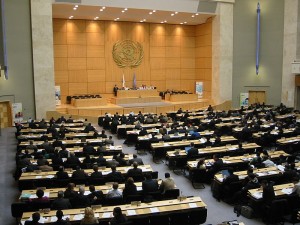
United Nations in Geneva. Photo: wiki commons.
The crisis over Syria is the third major case of mass murder in the last 20 years in which the U.N. has completely failed to halt the continuing bloodshed. The inability of the U.N. to intervene in the previous crises in Rwanda and Srebrenica (Bosnia) caused many commentators to charge that the U.N. was becoming a bankrupt organization, that was not fulfilling one of its main original purposes.
After all, the U.N. was established in 1945, when the horrors of the Holocaust were on the minds of its founders. One of its most critical early documents, the 1948 Universal Declaration of Human Rights, spoke of the “barbarous acts which have outraged the conscience of mankind.” It was clear that the U.N. was founded to prevent this sort of mass murder from ever recurring. In that spirit, the U.N. General Assembly also adopted the Genocide Convention at the same time.
However, in the 1990s, the U.N. proved to be completely ineffective in halting the very acts of genocide it was intended to prevent.
In 1994, the commander of the U.N. forces in Rwanda, Gen. Romeo Dallaire, sent a cable to U.N. headquarters in New York saying that he had information from an informer that the country’s Hutu leaders were planning to massacre Rwanda’s Tutsi population. Dallaire wrote that he planned to destroy the Hutu militias’ weapons depots. The head of U.N. peacekeeping, Kofi Annan, cabled back instructions to Dallaire to refrain from interfering. In the months that followed, some 800,000 Rwandans were butchered. The U.N. Security Council debated what action should be taken but ultimately did nothing; the Rwandan regime in fact sat on the council as a legitimate diplomatic partner.
The failure of the U.N. to stop mass murder continued. After the outbreak of the Bosnian War, the U.N. Security Council created a “safe area” for Bosnian Muslims in the area of the town of Srebrenica. The U.N. commander declared to the Muslim population that had fled to Srebrenica: “You are under the protection of the United Nations.” He added: “I will never abandon you.” Yet, in July 1995, the Bosnian Serb army assaulted the Srebenica enclave and began systematically killing 8,000 Muslims who lived there.
When tested, the U.N. peacekeeping force did not protect the Muslims. Its Dutch battalion fled. The Dutch press reported that while the massacres were underway, the peacekeepers held a beer party in the Croatian capital of Zaghreb. The U.N. launched an internal investigation about Srebrenica. The report concluded by saying that “the tragedy of Srebenica will haunt our history forever.”
Last year, when President Barack Obama looked at the offensive operations of Libyan President Moammar Qaddafi’s forces near Benghazi, his advisers said that if the West did not stop them the result would be “Srebenica on steroids.”
Now the U.N. has the new Srebenica it wanted to avoid. The Syrian uprising began in March 2011. While the U.N. Security Council debated over a period of months, more Syrian civilians died. A draft resolution proposed in October 2011 was vetoed by the Russians and the Chinese. At the end of May this year, the Security Council finally condemned Syria after the killing of 108 civilians in Houla. But it did not pass a resolution with any concrete measures.
Another failed U.N. initiative involved former U.N. Secretary-General Kofi Annan, who was appointed as a special envoy to deal with the Syrian crisis by the U.N. and the Arab League in February. A month later he announced a six-point plan that went nowhere. As long as the Annan mission persisted, the West could say that it supported his efforts and had an excuse to wash its hands from taking any measures against Syrian President Bashar al-Assad by itself over the last three months.
In the meantime, so far more than 14,000 Syrians have been killed. Yet again, the U.N. is failing to fulfill one of its original purposes: preventing the mass murder of innocent civilians.
The reason why the U.N. fails time and again to halt mass murder and even genocide is because of the interests of its member states. It refuses to take a firm moral position condemning those who perpetrate massacres and then it refrains from imposing effective measures against them. In the case of the Darfur rebellion, which began in 2003, while the U.S. called the actions of the Sudanese army “genocide,” the U.N. refused to adopt the same term and adopted ineffective actions for the following eight years, while thousands died.
There are two lessons for Israel from the international response to the Syrian crisis. First, the behavior of the U.N. proves yet again that Israel must never compromise its doctrine of self-reliance when its own security is at stake by relying on the protection of international forces.
A second lesson is how Israel should relate to the constant criticism it receives from various U.N. bodies. On May 28, the Wall Street Journal called the U.N. an “accomplice” to the murder of civilians in Houla, Syria, as it was in Srebrenica, Bosnia, in 1995. This was harsh criticism but contained a kernel of truth that cannot be ignored: The U.N. raises expectations that it will offer effective protection to people facing extermination, and in the end does nothing to stop repeated cases of aggression against them, frequently with its forces standing by while innocents are killed.
If the U.N. is a paralyzed body that cannot take decisions about cases of genocide, treating aggressors and their victims equivalently, then why should Israel listen to its moral judgments about the Israeli-Palestinian conflict? What can a U.N. with such glaring defects tell Israel about Gaza? Who exactly are its international civil servants who issue statements about Israel?
Indeed, the Syrian crisis is just the latest example of how the U.N. has lost the moral authority it had when it was founded. Israel must internalize the change in the U.N.’s status the next time a U.N. official decides to issue another politicized “condemnation” about its actions.
This article first appeared in Israel Hayom.