






Review: The Possession “Possesses Scant Authenticity”
Error: Contact form not found.

 by Saul Sudin

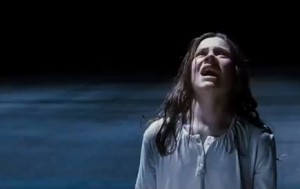
The possession screenshot.
What can one do to reinvigorate the often tired and predictable horror genre? For a category of movies infinitely reliant upon upping the ante and scaring your audience in new and unexpected ways, the best of our filmmakers often strive to creatively answer this question. Many times, the answer is found in reality. After all, what is scarier than the true life horrors and their filmic counterparts in The Texas Chainsaw Massacre (murderer Ed Gein), The Hills Have Eyes (Scottish cannibal legends the Sawney Bean family), or The Amityville Horror (a haunted house on Long Island, NY)? For horror innovator Sam Raimi and his producing partner Rob Tapert, they found their inspiration for the newly releasing The Possession in a real life Dybbuk box that had left a trail of ill-fated and unbelievable scares before ending up on eBay in 2004, where it made national news. Unfortunately, by the time this questionably haunted object steeped in Jewish folklore made its way to the big screen directed by Ole Bornedal with a script by Juliet Snowden and Stiles White, any real horror was stripped away by an adaptation bogged down in clichés and disjointed themes.
The film opens with the mysterious torture of an elderly woman who is under the control of whatever spirit emanates from the old, wooden Dybbuk box. She is thrashed about the room by an unknown force, seemingly punished for attempting to harm or destroy the box which sits upside down on her mantle, making it difficult for even those audience members who can read Hebrew letters to discern the writing on its side. In any film, there are rules established about what a supernatural power is capable of but here the ability to maim or kill nearby people at will is used inconsistently throughout the film- wherever convenient for the box protecting itself from those that would seek to harm it- and yet, we wait and wait and it never uses this ability on our protagonist, good guy basketball coach Clyde Brenek (Jeffrey Dean Morgan), whose daughter Em (Natasha Calis) becomes infatuated with the box after purchasing it at the old woman’s garage sale. Em and her older sister Hannah (Madison Davenport), both at awkward pubescent ages, are dealing with the recent divorce of their dad from their mother Stephanie (Kyra Sedgwick),who is dedicated to undercutting Clyde at every stage, whether it is quickly excising his things from their old house or flaunting her new boyfriend Brett (Grant Show).
For the first half of the movie, the scares are minimal and the main focus is on the family’s dramatic dynamic. This potentially could work to the film’s favor, as in the case of Psycho or Jaws, but instead the filmmakers felt it necessary to remind us we are watching a horror movie by throwing in lame fake outs and very sudden cuts to black with ominous music. Scenes come and go with sudden aggression, with no logic and chunky conclusions. What is the point of showing us a doggie door in the remote new house Clyde moves into if it is only going to serve the exact purpose you assume it will later on- that of a misdirected scare that ends up just being a raccoon in search of a meal? And the score, by Anton Sanko, is a pastiche of better known horror themes, cribbing from John Williams’ Jaws, John Carpenter’s Halloween, and others.
Eventually, as Em progressively falls under the spell of whatever is in the box, she becomes obsessively connected to it. She stabs her father with a fork because of it, beats up a kid in school over it, and sits among thousands of moths that mysteriously emanate from it. The box even murders her school teacher, who for whatever reason was grading papers completely alone in the classroom in the middle of the night. Em grows distant and detached from her formerly perky young self, and The Possession misses a grand opportunity to thematically deal with the dawning adulthood of a young girl in the form of a horror allegory. There are hints that this was considered, with lines such as “Daddy, you scare me”, “Who am I mommy?”, and “That is no longer your daughter!” in addition to quieter moments that focus on body development, her older sister’s very teenage rebellion form of dealing with the parent’s divorce, and an inability to communicate with the new man in her mother’s life. There is even a scene where the girl is eating forcefully straight out of the refrigerator and her mother approaches, only to end in shattered objects and blood from both Em and her mother. The film’s best moment comes when Em is in her bed clothes and thrashes violently as if being hit in the face while her father looks on in horror. From the perspective of her sister Hannah, she has given the impression that Clyde is the one smacking her inappropriately, and it turns the entire family (and police) against him. Clyde’s authenticity throughout is a credit to Jeffrey Dean Morgan, who singlehandedly holds up the entire movie from collapsing around him. Not quite as strong is Kyra Sedgwick, who is given little to work with as the divorce and her hatred of her ex-husband is never fully formed. With the few strong thematic moments never coming to allegorical fruition, the film is by far more interested in scares of the moment than deeper symbolism.
In this regard, the religious element overtly sinks in as Clyde desperately tries to figure out what is wrong with his daughter. From the outset we are instantly introduced to religion as a theme through a reproduction of DaVinci’s The Last Supper on the wall of the old woman’s home in the film’s opening shot (indicating the old woman isn’t quite the holocaust survivor that bequeathed the box in the real eBay story) and a sign that reads “Remove Thy Shoes” at the entrance to the Brenek’s house in the first shot that takes place there, both Christian overtones in a film that builds to a supposedly Jewish story device and characters. Clyde is given direction for what the box is by an unexplained “expert” professor friend character that pops up for the one scene and is never mentioned before or after. Clyde is introduced to the concept of a Dybbuk, a spirit that is stuck between worlds in Jewish folklore, and how it is connected to this Polish artifact box with no obvious latches from the outside. This spurs Clyde to investigate Dybbuk exorcises online, inexplicably finding several YouTube clips of Hassidim performing them (this is an incredibly preposterous concept in a world where this group would sooner ban video cameras and internet usage for non-business applications, and which implies that there must be some kind of Ghostbusters operation based out of Boro Park, Brooklyn- the one set of videos that do exist on YoutTube on the subject have been proven to be fake). Soon enough, Clyde is on his way to 18th Avenue and Utrecht in Boro Park, where what is possibly the film’s strangest scene takes place.
As Clyde drives up under the elevated F train, the street, populated with hundreds of bustling Hassidic people inexplicably becomes abandoned as everyone files into whatever store is closest to them at that moment. The situation is never explained, and it is not done with any particular speed or reaction to Clyde’s presence implying fear, everyone just goes away. This sets up Clyde hearing singing from down the road, and he finds Tzadok, played by a then-still Hassidic looking Matisyahu. The modern feel of the headphone listening, singing to himself Tzadok is so winking and on the nose, it is jarring in a film that otherwise tries to transport the audience to a pseudo reality that The Possession otherwise inhabits. What is further jarring is that Tzadok, as played by someone with actual experience living a Hassidic lifestyle, feels like the only lived-in, authentic Jew in the entire film, plot devices aside. Tzadok introduces Clyde to his father the Rebbe and his acolytes, who suffer from “Inaccurate Hollywood Hassidic Person syndrome” and speak only in Yiddish except when dramatically poignant at the end of a scene. I’m not sure where Production Designer Rachel O’Toole found her inspiration for the Rebbe’s room/The Hassidic Synagogue or whatever that room was, but it is horribly unrealistic with its almost pitch black lighting except for candles and stained glass windows, and a roaring fireplace in the same place where the elite Hassidim are praying together. The Hassidim reject Clyde’s problem citing too much danger, but Tzadok steps up to help citing Pekuach Nefesh, the idea that religious rules can be bent for the sake of saving a life, the one authentically Jewish moment in the film.
From here the film roars towards a dramatic conclusion that takes place in a hospital, and an exorcism is attempted by the admittedly clueless Tzadok (we have to assume that every young Hassidic son of a Rebbe has SOME exorcism training, right?!). Once again, the film attempts to set up rules that it then refuses to adhere to, by having Tzadok explain the ritual in detail involving bowls of oil and water (symbolizing oil as the source of light and water as the source of darkness) and chanting the V’Ahavta Torah verses that are part of the Shema, a central prayer in Judaism. In a nice touch, while Tzadok is praying, Clyde reads along in an Artscroll prayer book. But the film then proceeds to forsake all ritual for another scene of intense cuts to black and in the end we are left with a few predictable twists and a completely out of left field deus ex machina conclusion that desperately begs the audience to allow a sequel. Filled with nonsense and a portrayal of Judaism that is out of date in an ever evolving world, The Possession can be recommended only to those who want to see Matisyahu wrestle with a little girl inhabited by a demon (it’s not as interesting as it sounds).


