







Reinterpreting Bible Scenes Illuminates New Meanings
Error: Contact form not found.

 by Jonathan Sacks

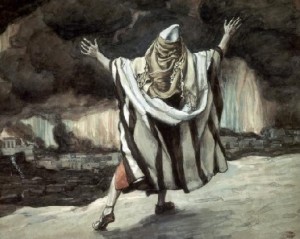
Abraham Sees Sodom in Flames, by James Jacques Joseph Tissot.
It is one of the most famous scenes in the Bible. Abraham is sitting at the entrance to his tent in the heat of the day when three strangers pass by. He urges them to rest and take some food. The text calls them men. They are in fact angels, coming to tell Sarah that she will have a child.
The chapter seems simple. It is, however, complex and ambiguous. It consists of three sections:
Verse 1: G-d appears to Abraham.
Verses 2-16: Abraham and the men/angels.
Verses 17-33: The dialogue between G-d and Abraham about the fate of Sodom.
How are these sections related to one another? Are they one scene, two or three? The most obvious answer is three. Each of the above sections is a separate event. First, G-d appears to Abraham, as Rashi explains, “to visit the sick” after Abraham’s circumcision. Then the visitors arrive with the news about Sarah’s child. Then takes place the great dialogue about justice.
Maimonides (Guide for the Perplexed II: 42) suggests that there are two scenes (the visit of the angels, and the dialogue with G-d). The first verse does not describe an event at all. It is, rather, a chapter heading.
The third possibility is that we have a single continuous scene. G-d appears to Abraham, but before He can speak, Abraham sees the passers-by and asks G-d to wait while he serves them food. Only when they have departed – in verse 17 – does he turn to G-d, and the conversation begins.
How we interpret the chapter will affect the way we translate the word Adonai in the third verse. It could mean (1) G-d or (2) ‘my lords’ or ‘sirs’. In the first case, Abraham would be addressing heaven. In the second, he would be speaking to the passers-by.
Several English translations take the second option. Here is one example:
The Lord appeared to Abraham . . . He looked up, and saw three men standing over against him. On seeing them, he hurried from his tent door to meet them. Bowing low, he said, “Sirs, if I have deserved your favour, do not go past your servant without a visit.”
The same ambiguity appears in the next chapter (19: 2), when two of Abraham’s visitors (in this chapter they are described as angels) visit Lot in Sodom:
The two angels came to Sodom in the evening while Lot was sitting by the city gates. When he saw them, he rose to meet them and bowing low he said, “I pray you, sirs, turn aside to your servant’s house to spend the night there and bathe your feet.”
Normally, differences of interpretation of biblical narrative have no halakhic implications. They are matters of legitimate disagreement. This case is unusual, because if we translate Adonai as ‘G-d’, it is a holy name, and both the writing of the word by a scribe, and the way we treat a parchment or document containing it, have special stringencies in Jewish law. If we translate it as ‘my lords’ or ‘sirs’, then it has no special sanctity.
The simplest reading of both texts – the one concerning Abraham, the other, Lot – would be to read the word in both cases as ‘sirs’. Jewish law, however, ruled otherwise. In the second case – the scene with Lot – it is read as ‘sirs’, but in the first it is read as ‘G-d’. This is an extraordinary fact, because it suggests that Abraham interrupted G-d as He was about to speak, and asked Him to wait while he attended to his guests. This is how tradition ruled that the passage should be read:
The Lord appeared to Abraham . . . He looked up and saw three men standing over against him. On seeing them, he hurried from his tent door to meet them, and bowed down. [Turning to G-d] he said: “My G-d, if I have found favour in your eyes, do not leave your servant [i.e. Please wait until I have given hospitality to these men].” [He then turned to the men and said:] “Let me send for some water so that you may bathe your feet and rest under this tree…”
This daring interpretation became the basis for a principle in Judaism: “Greater is hospitality than receiving the Divine presence.” Faced with a choice between listening to G-d, and offering hospitality to [what seemed to be] human beings, Abraham chose the latter. G-d acceded to his request, and waited while Abraham brought the visitors food and drink, before engaging him in dialogue about the fate of Sodom.
How can this be so? Is it not disrespectful at best, heretical at worst, to put the needs of human beings before attending on the presence of G-d?
What the passage is telling us, though, is something of immense profundity. The idolaters of Abraham’s time worshipped the sun, the stars, and the forces of nature as gods. They worshipped power and the powerful. Abraham knew, however, that G-d is not in nature but beyond nature. There is only one thing in the universe on which He has set His image: the human person, every person, powerful and powerless alike.
The forces of nature are impersonal, which is why those who worship them eventually lose their humanity. As the Psalm puts it:
Their idols are silver and gold, made by human hands. They have mouths, but cannot speak, eyes, but cannot see; they have ears, but cannot hear, nostrils but cannot smell… Their makers become like them, and so do all who put their trust in them. (Psalm 115)
You cannot worship impersonal forces and remain a person: compassionate, humane, generous, forgiving. Precisely because we believe that G-d is personal, someone to whom we can say ‘You’, we honor human dignity as sacrosanct. Abraham, father of monotheism, knew the paradoxical truth that to live the life of faith is to see the trace of G-d in the face of the stranger. It is easy to receive the Divine presence when G-d appears as G-d. What is difficult is to sense the Divine presence when it comes disguised as three anonymous passers-by. That was Abraham’s greatness. He knew that serving G-d and offering hospitality to strangers were not two things but one.
One of the most beautiful comments on this episode was given by R. Shalom of Belz who noted that in verse 2, the visitors are spoken of as standing above Abraham [nitzavim alav]. In verse 8, Abraham is described as standing above them [omed alehem]. He said: at first, the visitors were higher than Abraham because they were angels and he a mere human being. But when he gave them food and drink and shelter, he stood even higher than the angels. We honour G-d by honouring His image, humankind.
To read more writings and teachings from the Chief Rabbi Lord Jonathan Sacks, please visit www.chiefrabbi.org.