










What American Generals Knew About Peace
Error: Contact form not found.

 by Jerold Auerbach


U.S. Secretary of State John Kerry, Israeli Justice Minister Tzipi Livni, and Palestinian Chief Negotiator Saeb Erekat. Photo: State Department.
By all indications, Israeli and Palestinian negotiators, propelled by the ubiquitous John Kerry, are wending their weary way nowhere. Their most recent kerfluffle concerned the future presence of Israeli soldiers along the Jordan River Valley, which Israel demands as a necessary deterrent to infiltration and an early warning system against Arab invasion through (or above) Jordan.
The negotiators, prodded by retired US general John Allen (Kerry’s military adviser), have been quibbling over whether a small Israeli military presence would be stationed along the border, or a larger force would patrol the nine-mile wide Jordan Valley, protecting the major north-south highway that links a chain of several dozen agricultural communities inhabited by nearly ten thousand Israelis. There is also disagreement over the duration of any Israeli military presence, whether for a minimum of ten years (as Israeli negotiators insist) or not even for ten minutes (as Palestinians demand).
Palestinian Authority president Abbas claims that any Israeli military presence would undermine Palestinian national sovereignty. Prime Minister Netanyahu refuses to delegate responsibility for Israeli security to international patrols (for reasons, remember south Lebanon and the Gaza-Sinai border). So, it seems, stalemate is assured.
Ever since 1967, when Israel’s stunning victory in the Six-Day War returned the Jewish people to their biblical homeland in Judea and Samaria (previously Jordan’s West Bank), Israeli military and security experts have wrestled with the future of this territory. Would it be retained by Israel, as the political and religious Right demanded; relinquished to the Palestinians, as the Left insisted; or divided? The most widely discussed postwar partition plan, presented by Cabinet minister Yigal Allon, proposed annexation of the Jordan Valley by Israel and return of the remainder of the West Bank to King Hussein of Jordan. It went nowhere.
Back then, as now, American military experts contributed their own recommendations for a territorial solution. Mark Langfan, a New York attorney who heads Americans for a Safe Israel and writes frequently about Israeli security issues, recently disclosed a top-secret U.S. Joint Chiefs of Staff Memorandum. Dated June 29, 1967, and signed by General Earle G. Wheeler (chairman of USJCoS), it focused on Israel’s security needs. For its time, and for its prescience, it remains an eye-opener.
The Wheeler memo analyzed Israel’s “defensible” borders. Rejecting the Jordan Valley limitations of the Allon Plan, the Joint Chiefs asserted that “from a strictly military point of view,” Israel would require “control of the prominent high ground running north-south” through the West Bank. And not only over the mountain ridge, but “a portion of the foothills” to the east to protect Israeli villages from artillery attacks. In translation, as Langfan indicates, the Israeli “military establishment,” which for years supported the far more geographically limited Allon Plan, opposed the military conclusions reached by the Joint Chiefs of Staff about Israel’s security needs. So much for Israeli intransigence.
The Joint Chiefs 1967 map of “Defensible” Israeli Borders is an eye opener:
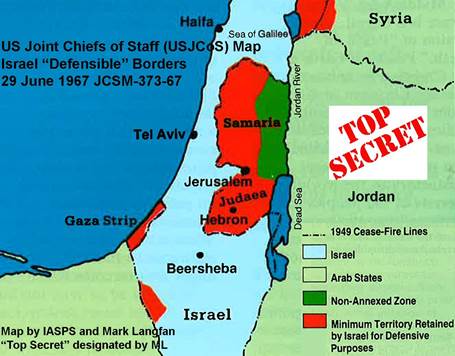
A depiction of U.S. Joint Chiefs of Staff 1967 map created by Mark Langfan.
The minimum territory recommended for Israeli security included all of Judea and the western half of Samaria. The “non-annexed zone” was confined to eastern Samaria, running from the northern tip of the Dead Sea to Israel’s pre-1967 border. And, as Langfan notes, that recommendation preceded the introduction of shoulder-fired anti-air missiles, chemical weapons, and laser guidance and radar detection that might be available to the next generation of Arab attackers.
To be sure, the Joint Chiefs’ report preceded the Oslo Accords, the illusion designed to bring peace now between Israelis and Palestinians that Secretary Kerry works so tirelessly to create. Twenty years later, however, it seems that American military experts may have known something that still eludes their Israeli counterparts. By now, even right-wing Israeli politicians have signed on to Palestinian statehood in at least part of the biblical Jewish homeland. The only issue is how much of the land west of the Jordan River, reserved ninety years ago by the League of Nations Mandate for “close settlement” by Jews, Israel will relinquish.
There are even Israeli military experts who claim that “there is no threat from the east” – as though local rocket armories, to say nothing of Iran, did not exist. To be sure, 1967 seems long ago. But perhaps the Joint Chiefs of Staff knew something about Israel’s security needs that still eludes many Israelis – and American diplomats.
Jerold S. Auerbach is author of the forthcoming Jewish State/Pariah Nation: Israel and the Dilemmas of Legitimacy to be published in 2014.


