



Pew Data Illustrates Distinct Skullcap Identities in Israel
Error: Contact form not found.

 by Alina Dain Sharon / JNS.org

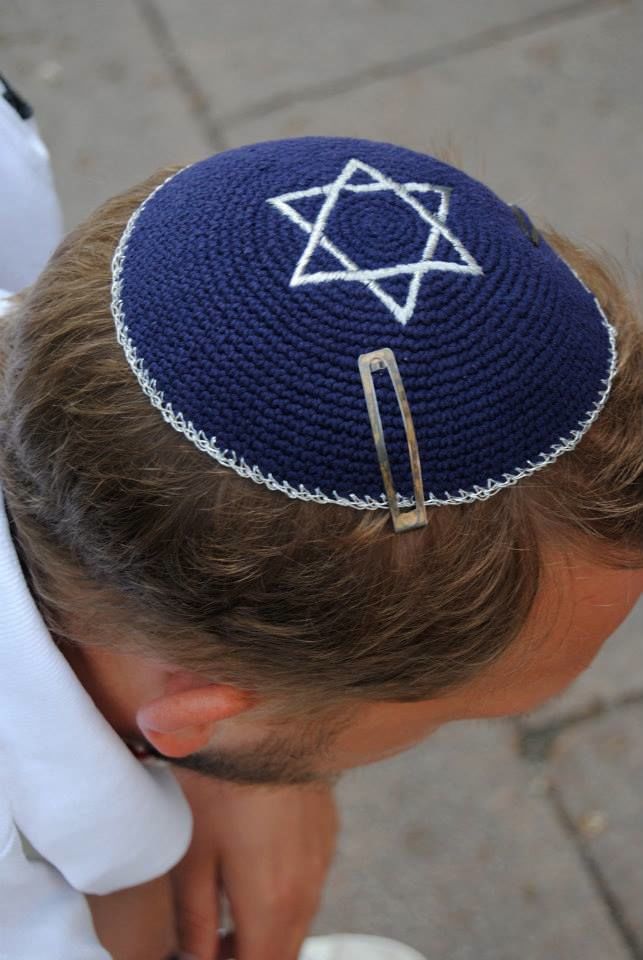
A man wearing a kippah. New data that illustrates what different skullcaps typically mean in Israel. Photo: Enough is Enough Facebook page.
JNS.org – The Pew Research Center has released new data that illustrates what different skullcaps (also known as yarmulkes in Yiddish or kippot in Hebrew) typically mean in Israel, in that the type of skullcap often indicates not only the wearers’ religious identity, but also their political identity. These identities are distinct from the Jewish denominations that exist in the US.
Kippot are worn by about one-third of Israel’s Jewish men. Among those Israeli men who wear black fabric kippot, 58 percent identify as haredi. Fifty-nine percent of those who wear a black crocheted or knitted kippah identify as masorti (“traditional”).
From a political standpoint, the Hebrew term “kippah sruga” (knitted kippah) is sometimes used to describe religious Zionist Jews who believe that the Jewish people are biblically entitled to the land of Israel. This is supported by data showing that among those who wear colored or patterned knitted kippot, 63 percent say they are being accurately described as “Zionist.”
See more statistics about skullcaps in Israel here, and in the following Pew Research Center infographic:
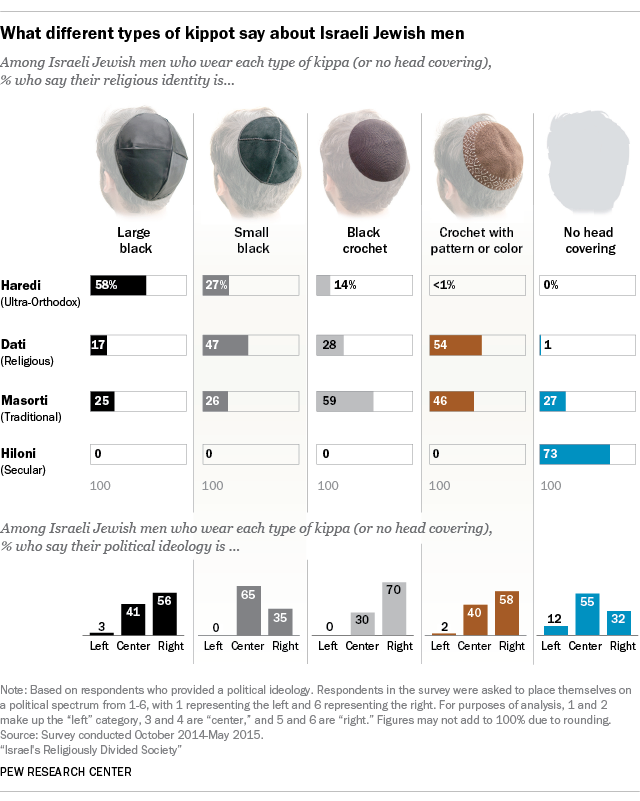
Photo: Pew Research Center.


