


Amid Political Turmoil at Home, Netanyahu Forges Ahead on Asia Pivot
Error: Contact form not found.

 by Sean Savage / JNS.org

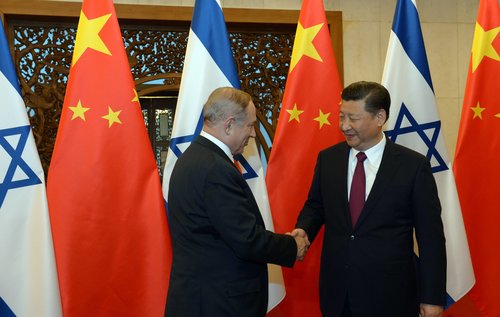
Israeli Prime Minister Benjamin Netanyahu and Chinese President Xi Jinping. Photo: Haim Zach/GPO.
JNS.org – As Israeli Prime Minister Benjamin Netanyahu faced ongoing turmoil within his governing coalition and criminal investigations back home, he continued his pivot to Asia by visiting China last week.
Netanyahu’s trip marked 25 years of Israeli-Chinese diplomatic relations, and was part of an effort to bolster the Jewish state’s relations with non-traditional allies. The prime minister had previously declared that Israel was “pivoting toward Asia” during a visit to Singapore in February.
“We admire China’s capabilities, its position on the world stage and in history,” Netanyahu told Chinese President Xi Jinping on March 21. “We have always believed…that Israel can be a partner, a junior partner but a perfect partner, for China in the development of a variety of technologies that change the way we live, how long we live, how healthy we live, the water we drink, the food we eat, the milk that we drink — in every area.”
The theme of economic and technological ties echoed throughout Netanyahu’s visit.
“We are in a technological age, on the one hand, and I think Israel and China can discuss many ways for technological cooperation,” Netanyahu said during remarks with Chinese Prime Minister Li Keqiang in Beijing on March 20.
Netanyahu, who was accompanied by a large delegation of Israeli business leaders, also met with the heads of nearly a dozen of China’s largest corporations to discuss investment in Israel. Netanyahu said that “a large portion [of those companies] are investing in Israel, and a large portion of them will invest in Israel. This means jobs, the development of businesses and a link to the major Chinese markets.”
Shu Meng, a research fellow at Shanghai University’s Middle East Studies Institute, said that despite the vast difference in size between the two countries, Israel is an important partner for China “due to friendship between the two peoples during World War II historically, and their close ties economically.”
“The economic aspect plays the most important role in the present-day Sino-Israeli relationship,” said Meng, who has lived and studied in Israel. “China is promoting its ‘One Belt, One Road’ strategy, and Israel is located along the road. The strategy may bring new vigor and new chances for bilateral economic cooperation.”
During Netanyahu’s visit, Israel and China signed bilateral agreements identifying a number of areas for increased cooperation, including “air pollution control, waste management, environmental monitoring, water conservation and purification, as well as hi-tech fields.” The nations also said that they plan to establish “a global technology transfer center, innovation parks and an innovative cooperation center.”
China’s Mideast engagement
While Netanyahu focused on economic ties, China’s President Xi called attention to the Israeli-Palestinian conflict, expressing hope for a peace deal “as soon as possible.”
“A peaceful, stable and developing Middle East is the common interest of all parties. … China appreciates [that] the Israeli side will continue to tackle the Israeli-Palestinian issue on the basis of the two-state solution,” Xi said, according to China’s Xinhua news agency .
Regarding the Israeli-Palestinian conflict, Meng said that China believes that “political negotiation is the only way to solve the problem,” and “[is] committed to promoting peace talks between the two [parties].”
Yet Meng explained that China’s influence in the peace process “lags behind some [other world] powers,” partly because “China itself is faced with a complicated geopolitical situation in surrounding areas.”
Relations between the peoples
Meng also said that many Chinese nationals have a favorable view of Israel and the Jewish people, due to the Israeli government’s public diplomacy efforts.
“Information on Israel can be frequently accessed on WeChat, which is a social app that is very popular in China, [as well as] other social apps and media,” Meng said. She also noted that Chinese travelers who visit Israel — for both business and pleasure — have brought the two peoples closer to each other.
But Meng said that while most Chinese individuals have a favorable outlook on Jews and Israelis, her personal experience studying in Israel showed her that the admiration does not necessarily go both ways.
“When I was a visiting student in Tel Aviv University, most people [were] very friendly there, but I still heard some negative and misunderstanding comments,” Meng said. “Most Chinese people have quite a good impression of Israeli people, but not vice versa. Hence, people-to-people communication should be further promoted.”
The Chinese government’s friendly relationships with Israel’s enemies — such as Iran — also provide a challenge to Chinese-Israeli relations. “Sensitive issues,” said Meng, “such as China’s relationship with Iran [and] China’s attitude toward Palestine always stand in the way of the development of the bilateral political relationship.”


