






Trump Must Withdraw From the Iran Nuclear Deal — Now
Error: Contact form not found.

 by John Bolton

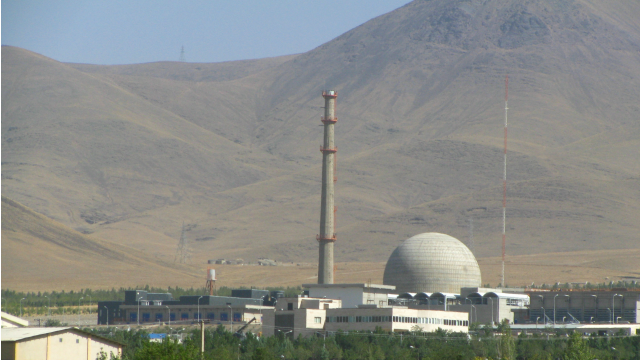
The heavy water reactor in Arak, Iran. Photo: Nanking2012 via Wikimedia Commons.
For the second time during the Trump administration, the State Department has reportedly decided to certify that Iran is complying with its 2015 nuclear deal with the UN Security Council’s five permanent members and Germany, known formally as the Joint Comprehensive Plan of Action (“JCPOA”).
If true, it will be the administration’s second unforced error regarding the JCPOA. Over the past two years, considerable information detailing Tehran’s violations of the deal have become public, including: exceeding limits on uranium enrichment and production of heavy water; illicit efforts at international procurement of dual-use nuclear and missile technology; and obstructing international inspection efforts (which were insufficient to begin with).
Since international verification is fatally inadequate, and our own intelligence far from perfect, these violations undoubtedly only scratch the surface of the ayatollahs’ inexhaustible mendaciousness.
Certification is an unforced error because the applicable statute (the Iran Nuclear Agreement Review Act of 2015, or “INARA”) requires neither certifying Iranian compliance nor certifying Iranian noncompliance. Paula DeSutter and I previously explained that INARA requires merely that the secretary of state (to whom President Barack Obama delegated the task) “determine…whether [he] is able to certify” compliance. The secretary can satisfy the statute simply by “determining” that he is not prepared for now to certify compliance and that US policy is under review.
This is a policy of true neutrality while the review continues. Certifying compliance is far from neutral. Indeed, it risks damaging American credibility should a decision subsequently be made to abrogate the deal.
Beyond the procedural question, however, is the importance of swiftly resolving the underlying policy gridlock. President Donald Trump has repeatedly made clear his view that the Iran deal was a diplomatic debacle. It is not renegotiable, as some argue, because there is no chance that Iran, designated by Ronald Reagan as a state sponsor of terrorism in January 1984, will agree to any serious changes. Why should it? President Obama gave them unimaginably favorable terms, and there is no reason to think China and Russia will do us any favors revising them.
Accordingly, withdrawing from the JCPOA as soon as possible should be the highest priority. The administration should stop reviewing and start deciding. Even assuming, contrary to fact, that Iran is complying with the JCPOA, it remains palpably harmful to American national interests. It should not have taken six months to reach this conclusion. Well before January 20, we saw 18 months of Iranian noncompliance and other hostile behavior as evidence. The Trump transition team should have identified abrogating the deal as one of the incoming administration’s highest policy priorities.
Within the Trump administration, JCPOA supporters contend that rejecting the deal would harm the United States by calling into question our commitment to international agreements generally. There is ominous talk of America “not living up to its word.”
This is nonsense. The president’s primary obligation is to keep American citizens safe from foreign threats. Should President George W. Bush have kept the United States in the 1972 Anti-Ballistic Missile Treaty, rather than withdraw to allow the creation of a limited national missile-defense shield to protect against rogue-state nuclear attacks? Was Washington’s “commitment” to the ABM Treaty more important than protecting innocent civilians from nuclear attacks by the ayatollahs or North Korea’s Kim family dictatorship?
Similarly, President Bush directed that we unsign the treaty creating the International Criminal Court because we had no intention of ever becoming a party. Was he also wrong to extricate American service members and intelligence personnel — not to mention ordinary citizens — from the risk of arbitrary, unjustified and politically motivated ICC detention and prosecution?
Of course, the answer is “no.” The president would be derelict in his duty if he failed to put the interests of US citizens first, rather than worrying about “the international community” developing a case of the vapors. The Trump administration itself has already shown the courage of its convictions by withdrawing from the Paris climate accords. Compared to that, abrogating the JCPOA is a one-inch putt.
We must also urgently reassess the available intelligence on issues like joint Iranian-North Korea nuclear and ballistic-missile programs, free from the Obama administration’s political biases. Cooperation between Tehran and Pyongyang is deep and long-standing. North Korea’s July 4 ICBM launch should cause greater interest in the implications for Iran.
Much of the current JCPOA debate would be strategically irrelevant if, as seems virtually certain, the ayatollahs can send a wire transfer to Kim Jong-un to purchase whatever capability North Korea develops.
In years past, appreciation for the Iranian and North Korean threats has invariably been enhanced by greater public awareness of what was at stake. One useful suggestion to that end was made last week by the Wisconsin Project’s Valerie Lincy. She advocated declassifying the fourth semi-annual report (also required by INARA) specifying incidents of Iranian non-compliance, the first from the Trump administration.
With appropriate protections for intelligence sources and methods, making this report public would undoubtedly help increase public awareness of Iran’s continuing progress, and thereby inform the broader policy debate.
In the last six months, Iran has made six more months of progress toward posing a mortal threat to America and its allies. This US approach is both dangerous and unnecessary. Care to bet how close Tehran — and North Korea — now are? Consider the costs of betting wrong.
John R. Bolton is a former US ambassador to the United Nations and a former undersecretary of state for arms control and international security affairs.
This article was originally published by The Hill.


