






How I Spent My Summer Vacation: Encountering Vile Antisemitism at NY’s Whitney Museum
Error: Contact form not found.

 by Douglas Altabef

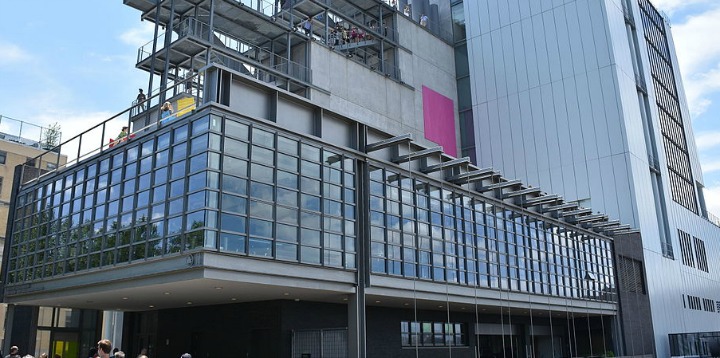
The Whitney Museum. Photo: Wikimedia Commons.
It has become part of my family’s post-aliyah ritual: the annual trip back to the Old Country, to visit the family and friends that we left behind.
Landing in New York early on the Friday before July 4, we put our bags down at our hotel, and decided to walk crosstown for a stroll on the High Line.
My artist wife then suggested that we visit the Whitney Museum of American Art, which used to be on upper Madison Avenue, but has moved to the trendy Meatpacking District at the southern end of the High Line. Having never been to the new Whitney, and — more significantly — having been outvoted by wife and daughter, that’s just what we did.
Entering the Whitney, we first visited the permanent exhibit of Alexander Calder mobiles — which are whimsical, colorful and invitingly accessible. We then visited other exhibits featuring Edward Hopper works, and those of other modern masters.
Finally, we walked down to the Biennial Exhibit, which is a six-month long exhibit that recurs every two years, and — presumably — features younger, up and coming, edgier artists. Not surprisingly, most everything we saw there was identity-based and grievance-oriented.
Suddenly, my wife shocked me out of my growing stupor: “You won’t believe what I just saw. It’s disgusting!” In response, I wandered over to a large table, where there were approximately ten sets of virtual reality glasses and headphones.
I had walked by the “exhibit” previously, not giving it a second thought. Now though, as I put on the virtual reality equipment, I saw a man holding a baseball bat bashing in the head of what appeared to be another man, who was lying on the ground. Disgusting and disturbing, to be sure.
However, almost immediately, there was a soundtrack: the Hebrew chanting of the blessing for lighting the Hannukah menorah. So, what I was seeing was the brutal massacre of one man by another, accompanied by the lilting blessing that precedes a beautiful, joyful mitzvah.
I watched and listened long enough for it to sink in, and then — literally shaking with revulsion — I ripped off the goggles and the headphones, and threw them onto the table.
I told my wife and daughter that we were leaving that second — and we were soon on the street, reeling with disbelief at what we had each experienced. Here — in the city of my birth, where I lived and worked for most of my pre-aliyah life — was a piece of art that would have brought a grin to Goebbels’s face.
Unsurprisingly, the work was created by a Jewish “artist,” one Jordan Wolfson.
Channeling both my Israeli-ness — and my Im Tirtzu disposition — I insisted that we return to the hotel. I promptly wrote a scathing letter of protest to the director of the Whitney, Adam Weinberg, as well as to a large group of friends, in Israel and America, telling them what had happened, and suggesting that they add their voices against this incredibly malevolent art piece.
I asked a well-connected friend to get my note to Leonard Lauder, the Jewish chairman mmeritus of the Whitney, and to other VIPs as well.
There is no doubt in my mind — as I pointed out to Weinberg — that had it been verses from the Koran that were read to accompany the violence, the exhibit would never have been shown. Nor if the soundtrack was of Toni Morrison’s work being read. This would have been deemed, completely offensive and totally unacceptable.
Subsequently, I have been shocked to read art reviews that either did not even comment on the fact that a Hebrew blessing was being chanted to accompany this violence, or remarked on it in the most matter-of-fact way. One reviewer did point out that the exhibit was antisemitic, but in the same way that she might have pointed out that the sun was shining.
There are bigger problems in the world — and the Jewish people are facing more serious challenges than art, both in Israel and the Diaspora. But make no mistake, this exhibit — titled “Real Violence” — is a shot across the bow, a marker of the deterioration of respect for the sacred in general, and a willingness to disparage Jews, in particular.
Not only that, but the fact that the artist and the museum director were Jews is both galling and frightening. I received a rather pro-forma response from Director Weinberg, saying that the museum would never countenance antisemitism. When I wrote back asking him to explain how the museum had determined that the piece was not antisemitic, he never responded.
The only thing that could be said in favor of the whole encounter was that the rest of the trip had to be better. The Biennial Exhibit is now thankfully closed, but, as the old song says, the memory lingers on.
Mr. Altabef is the chairman of the board of Im Tirtzu, and a board member of The Israel Independence Fund. He can be reached at dougaltabef@gmail.com.


