



Is Jordan Burning?
Error: Contact form not found.

 by Eyal Zisser / Israel Hayom / JNS.org

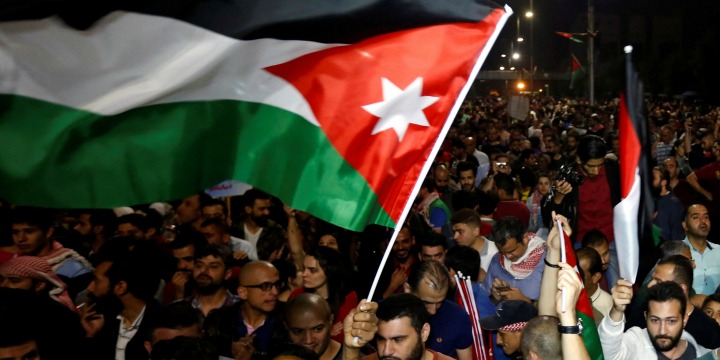
A protester holds up a Jordanian national flag during a protest in Amman, Jordan, June 4, 2018. Photo: REUTERS/Muhammad Hamed.
JNS.org – In recent years, Israel has stood alongside Jordan against a bevy of diplomatic and security challenges — the majority stemming from neighboring Syria — that have jeopardized stability in the kingdom. Initially, there was concern that the Islamic State would infiltrate Jordan to wage a terror campaign and amass influence. More recently, concerns have focused on the menace posed by Iran and Hezbollah, which are aspiring to establish a foothold in south Syria from which to threaten the Hashemite Kingdom. These entities view Jordan as a pro-Western, Sunni obstacle in their path to control of the Fertile Crescent.
Over the past several weeks, however, it has emerged that Jordan’s challenge isn’t necessarily external; rather, it’s domestic. During this time, the kingdom has seen widespread public protests, perhaps unprecedented in scope, due to soaring prices and government tax hikes.
At first, the protests didn’t garner much attention. To be sure, Jordan has known public discord over various economic crises in the past, but King Abdullah has always mitigated them and ensured the people’s continued support.
Jordan’s supposed invulnerability to domestic crises was especially noticeable with the outbreak of the Arab Spring at the beginning of the decade. The explanation given was that the Jordanian monarchy enjoyed a level of legitimacy and hadn’t aroused the same antagonism as dictatorships in Egypt and Syria. Another factor was that sensible Jordanians saw the effect of the Arab Spring in other Arab countries, such as Syria, which quenched their appetite for reforms and change.
Yet it is now apparent that peace and quiet cannot be bought indefinitely, and that precarious economic realities will inevitably explode.
In recent years, Jordan has undergone a demographic revolution that has drastically changed the face of the country. It used to be that every second Jordanian was a Palestinian, with all that it entails. Today, however, every second Jordanian is a refugee from Iraq or Syria — four million out of 11 million residents of the kingdom.
These refugees, who probably won’t return to their own countries, are a heavy burden on the Jordanian economy. What’s more, the kingdom’s economy is still a traditional one. That is to say, it’s faltering, bereft of energy sources and water — for which it relies on Israel — and struggling to provide employment to an ever-growing population.
Similar to other instances in the past, King Abdullah was quick to try to alleviate the recent tensions.
First and most importantly, he avoided the use of force. There have been no casualties and the protests have not turned violent. Secondly, he sacked the government in the hope of deflecting the public’s anger away from the monarchy and himself. Finally, he canceled the unpopular price and tax increases, which, incidentally, were demanded by the International Monetary Fund as a prerequisite for providing economic aid to Jordan. Now that these austerity measures have been shelved, this aid likely won’t be given.
Despite the steps implemented by the king, however, the ember of dissent continues to smolder in Jordan. This dissent, meanwhile, is buttressed daily by additional factors, continually upping the ante and expectations. The protests are no longer aimed solely at terminating tax hikes and cabinet dismissals, and similar to Syria or Egypt, they could lead the country into a murky future.
But Jordan hasn’t crossed the Rubicon yet — and many hope that the king will succeed, as he always has, to lower the flames.
Still, we should view these developments in Jordan as a warning signal, as the deep-seated causes remain unresolved. Either way, Jordan is now mired in the storm of instability afflicting our region. Its challenge is two-fold: the Iranian-Shiite threat from abroad and the economic crisis at home, which Islamist elements in the kingdom, with help from Tehran, are liable to exploit.
Eyal Zisser is a lecturer in the Middle East History Department at Tel Aviv University.


