





Message to UN and Europe: Palestinian Terrorism Always Violates International Law
Error: Contact form not found.

 by Louis René Beres

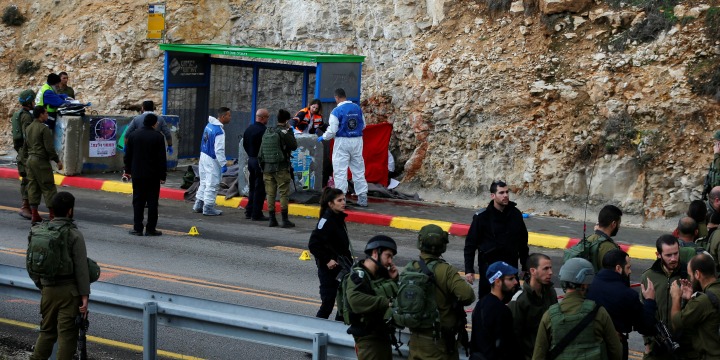
Israeli soldiers and medics are seen at the scene of a terrorist attack Givat Asaf Junction in the West Bank, Dec. 13, 2018. Photo: Reuters / Ammar Awad.
There can never be any greater form of power in world politics than power over death. Paradoxically, this pre-eminent form of power is almost entirely unrecognized by both scholars and policymakers. The principal result is that in terror-vulnerable countries such as Israel, counter-insurgency strategies remain all too frequently detached from what is most important.
Consider the issue of Palestinian terrorism, most recently made manifest in the December 9 Ofra Junction (Samaria) shootings. Notwithstanding the conventional wisdom that this conflict is essentially about land or territory, the overriding expectation of Palestinian “martyrs” is actually about immortality. Indeed, life everlasting represents the very definition of what Palestinian martyrdom is all about.
Without exception, those jihadist insurgents are defiling the law. Even if relentless Palestinian calls for “self-determination” were correctly grounded in jurisprudence, these terrorists would remain forever tainted by operational wrongdoings.
Following an earlier vote by the UN General Assembly, “Palestine” is now fully justified to identify itself as a “nonmember observer state.” Although such a designation essentially by-passes the more usual normative expectations regarding statehood, especially the Convention on the Rights and Duties of States (1934), much of the world is apparently ready to accept the reality of full Palestinian sovereignty. It also now also seems that US President Donald Trump has informally offered Palestinians some inchoate sort of confederation.
Under international law, even the most “sacred” rights of insurgency exclude the intentional targeting of civilians and/or the use of force to inflict gratuitous suffering. Therefore, it is always terrorism when Palestinian insurgents murder Israeli families in their homes or automobiles by stabbing and shooting. It is also always terrorism whenever such “martyrs” systematically deposit their nail-filled bombs on Israeli buses or school playgrounds.
Sometimes the Palestinian insurgents advance a discredited legal argument known generally as tu quoque. This argument stipulates that because the other side is allegedly guilty of similar, equivalent, or even greater criminality, “our” side is automatically free of any legal wrongdoing. Such a disingenuous argument is always invalid, especially after the landmark postwar judgments of both the Nuremberg and Far East tribunals.
In brief, for both conventional armies and insurgent forces, the right to armed force can never supplant the peremptory rules of humanitarian international law. Indeed, for more than 2,000 years, unassailable and conspicuous legal principles have specified that intentional violence against the innocent is always prohibited.
One man’s (or woman’s) terrorist, can never be another man’s (or woman’s) “freedom fighter.” Although it is true that certain insurgencies can sometimes be judged fully lawful or distinctly law-enforcing, even such resorts to force must still conform to the laws of war.
Always.
Whenever an insurgent group resorts to manifestly unjust means, its actions constitute terrorism. Even if now ritualistic Palestinian claims of a hostile “occupation” were to be accepted as reasonable, corollary claims of entitlement to “any means necessary” would remain patently false.
National liberation movements that fail to meet the test of just means are never correctly protected as lawful or legitimate. Even if law were somehow to accept the questionable argument that Palestinian Authority, Hamas, and assorted sister groups had fulfilled the accepted criteria of “national liberation,” they could still not satisfy the equally relevant legal standards of discrimination, proportiona
More precisely, these critical standards were authoritatively applied to insurgent or sub-state organizations by the common Article 3 of the four Geneva Conventions of 1949, and (additionally) by the two 1977 Protocols to these Conventions.
Standards of “humanity” are also binding upon all combatants by virtue of certain broader customary and conventional international law, including Article 1 of the Preamble to the Fourth Hague Convention of 1907. This rule, commonly called the “Martens Clause,” makes all persons responsible for the “laws of humanity,” and for the associated “dictates of public conscience.”
Under relevant international law, even at the hands of a “nonmember observer state,” the ends can never justify the means. And under compulsory international law, terrorist crimes mandate universal cooperation in both apprehension and punishment. As punishers of “grave breaches” under international law, all states are expected to search out and prosecute or extradite, individual terrorists. In absolutely no conceivable circumstances are states permitted to regard terrorist “martyrs” as “freedom fighters.”
In law, rights can never stem from wrongs. Even if Israel’s Palestinian adversaries continue to insist on treating the most recalcitrant jihadist insurgents as “martyrs,” such treatment could have no exculpatory or mitigating effect on attendant terrorist crimes. Irrespective of the justness of cause — and this includes any alleged rights to full sovereignty for “Palestine” — nothing under international law can ever justify the deliberate targeting of non-combatant populations.
Most noteworthy of all, perhaps, is that Israel’s jihadist foes are ultimately in search of the most plainly incomparable form of power on earth; that is, power over death. Accordingly, Jerusalem’s counter-terrorism policymakers ought never lose sight of the “future of immortality.” In the end, power over death will trump any other more tangible forms of power based upon various weapon systems or on narrowly competitive orders of battle.
Louis René Beres was educated at Princeton (Ph.D., 1971) and is the author of many books and articles dealing with terrorism and international law. Dr. Beres, who is Emeritus Professor of International Law at Purdue, was born in Zürich, Switzerland, on August 31, 1945. He is a frequent contributor to Harvard National Security Journal (Harvard Law School); JURIST; Case Western Reserve Journal of International Law; Yale Global Online; Bulletin of the Atomic Scientists; The War Room(Pentagon); The Strategy Bridge; Israel Defense (IDF); The Modern War Institute (West Point); Parameters: Journal of the US Army War College (Pentagon); and Oxford University Press. His latest and twelfth book is Surviving amid Chaos: Israel’s Nuclear Strategy (Rowman & Littlefield, 2nd ed., 2018). https://paw.princeton.
A version of this article was originally published by Arutz Sheva.


