


Israel Accuses European Court of Applying ‘Double Standard’ With Ruling Ordering Labeling of Settlement Goods
Error: Contact form not found.

 by Reuters and Algemeiner Staff

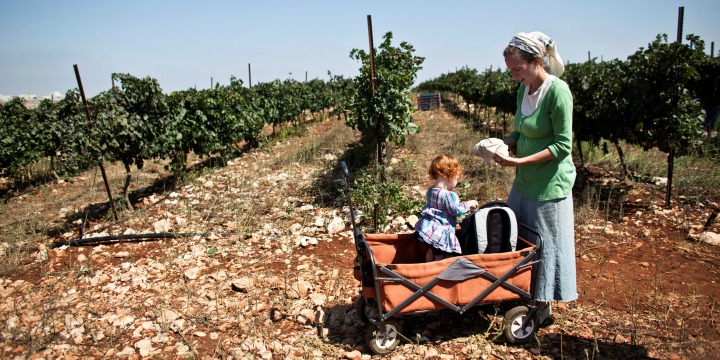
A Christian volunteer stands with her child in a vineyard during grape harvest in the Israeli settlement of Har Bracha, near Nablus, in the West Bank, Sept. 3, 2013. Photo: Reuters / Nir Elias.
The EU’s top court ruled on Tuesday that goods from Israeli settlements must be labeled as produced in occupied territory, a decision hailed by Palestinians and condemned by Israel, which said it would try to persuade countries to ignore it.
The Luxembourg-based European Court of Justice said labels must not imply that goods produced in occupied territory came from Israel itself.
Labels must “prevent consumers from being misled as to the fact that the State of Israel is present in the territories concerned as an occupying power and not as a sovereign entity,” the court said.
The case focused on a winery in the West Bank, but the court referred to all territory Israel took control of in the 1967 Six-Day War, including East Jerusalem and the Golan Heights, both of which Israel has annexed.
As well as wine, Israeli farmers grow and package herbs, fruits and vegetables in the territories, many of which have been exported to the EU and labeled as “Product of Israel.”
Israel‘s Foreign Ministry said it “strongly rejects” the ruling “which serves as a tool in the political campaign against Israel.” Foreign Minister Yisrael Katz said he would work with foreign ministers of EU countries to prevent its implementation.
“The ruling’s entire objective is to single out and apply a double standard against Israel. There are over 200 ongoing territorial disputes across the world, yet the ECJ has not rendered a single ruling related to the labeling of products originating from these territories,” the ministry said.
Saeb Erekat, the Palestinian Authority’s chief negotiator, welcomed the ruling and called on all EU countries to “implement what is a legal and political obligation.”
Palestinians want to establish a state on territory captured by Israel from Jordan and Egypt in 1967. They argue that Israeli settlements in these areas are an unlawful violation of the Geneva conventions and multiple UN resolutions. Israel denies that its settlements break international law.
In its ruling, the EU court said settlements involved the transfer of Israelis outside the state’s territory “in violation of the rules of general international humanitarian law.”
As a result, failing to inform EU consumers they were potentially buying goods produced in settlements denies them access to “ethical considerations and considerations relating to the observance of international law,” it said.