








Aharon Appelfeld’s ‘To The Edge of Sorrow’ Asks the Right Questions
Error: Contact form not found.

 by Ira Stoll

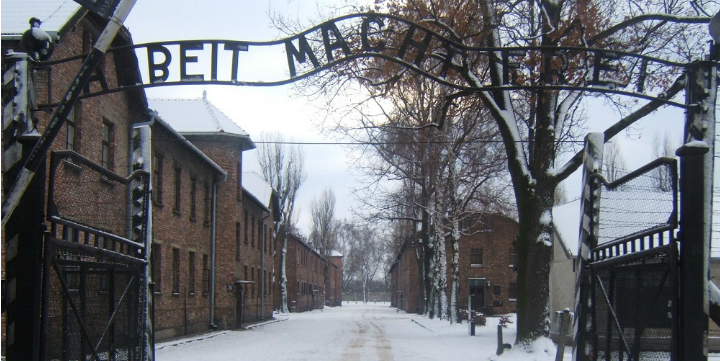
The main gate at the Auschwitz concentration camp. Photo: Auschwitz-Birkenau Memorial and Museum.
The Israeli novelist Aharon Appelfeld died in 2018. His novel To the Edge of Sorrow, published in Israel in 2012, is out this week in English from Schocken Books, translated by Stuart Schoffman.
The book is set during the Holocaust. Amid recent news reports of violent antisemitism in America, a story about partisan fighters weathering a bleak Eastern European winter while trying unsuccessfully to prevent genocide stuck me as a potential downer. All the more so because, notwithstanding its title, the tale at times goes far beyond the “edge” of sorrow and ends up deep in the depths of it: “One of the fighters once sank into a depression so deep it seemed he was finished. … His face grew grayer by the hour, and he was on the edge of collapse.”
Don’t be scared away by the topic or the title, though: It’s actually a tale with inspiring, even uplifting themes, told in a suspenseful way that makes you feel like you are right there in the woods during World War II. The leader of the band of partisans, Kamil, is described as saying, “If we will learn to conquer despair, to stay fixed on our goal, and to understand that being a Jew is no small matter, we will live to see the downfall of the enemy.” Or, in other words, “Kamil wants to instill in us the feeling that it is impossible to fight a determined enemy without love of the tribe, its God, and its beliefs.” Kamil quotes the Talmud: “He who comes to kill you, kill him first.”
The narrator, Edmund, had before the war dated a non-Jewish woman. She asked him, “Why do people hate the Jews?” This is a question still on people’s minds in contemporary reality.
The questions in this book are some of the liveliest dialogue. “How do we know that God is in the world?” one character asks. “Why don’t I see him?”
A character in the book named Grandma Tsirl tries to answer. “Earlier generations saw God everywhere, even in the lowliest mosses; in our generation there is great blindness, and people see only what the physical eye can see. … Open your eyes and look inside. God is within you.”
These are questions for pondering by professors and rabbis and historians and theologians and for newspaper reporters and columnists. But they are also questions for novelists, for literature. That the questions persist are a sign they are less about the Jewish situation than about the Jewish condition, or, perhaps even for the universalists among us, the human condition. Appelfeld is dead, but people will still be reading him for years, asking his characters’ questions and, one hopes, learning from their answers.
Ira Stoll was managing editor of The Forward and North American editor of The Jerusalem Post. His media critique, a regular Algemeiner feature, can be found here.