



Israel’s New Government: Bloated and Wasteful, but Necessary at the Moment
Error: Contact form not found.

 by Benjamin Kerstein

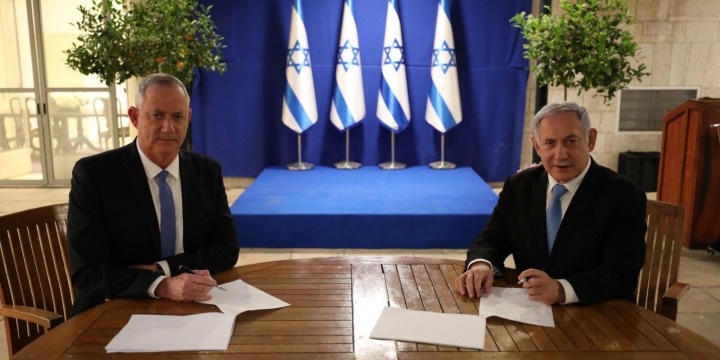
Blue and White leader Benny Gantz and Prime Minister Benjamin Netanyahu sign a coalition agreement, ending Israel’s year-long political impasse, April 20, 2020. Photo: Twitter.
Criticizing the government is the Israeli national pastime, and the newly sworn-in unity coalition led by Prime Minister Benjamin Netanyahu and Alternate Prime Minister Benny Gantz is no exception.
Besides ideological concerns about issues like a possible annexation of parts of the West Bank, one of the most prominent criticisms has been the size of the government itself. There is no doubt that the criticism is largely true: this government is the largest in Israel’s history, with 36 ministers, and is going to cost a great deal of money to maintain, something deeply ironic given both Gantz and Netanyahu’s assertion that one of the reasons for forming the government was to avoid a hugely expensive fourth election.
Attacks on the new government have not been slow in coming. As early as last month, when the coalition was still being formed, Globes analyst Tal Schneider called the prospective government “grotesquely and irresponsibly bloated” and “the most profligate government in the country’s history.”
New opposition leader Yair Lapid has been the most outspoken critic, saying on Monday shortly after the government was sworn in, “Yesterday they stood at the podium and talked about ‘the plight of Israeli citizens.’ If their plight was of interest to you, you wouldn’t have established this obscenely wasteful government.”
“No more than 18 ministers are needed to run the country,” Lapid asserted. “They built a government three times the size. It won’t cost a billion shekels — it’ll cost a lot more.”
Lapid, of course, is quite right in objective terms, and in his statement there is the implication of a more systemic problem. Indeed, there is no doubt that the composition of nearly all Israeli governments — and the current one is not larger than many of its predecessors by all that much — has been determined more by political and parliamentary considerations than such virtues as thrift, competence, and the public interest.
This is rooted in Israel’s dysfunctional electoral system, which inevitably leads to dysfunctional governance. Since the entrance threshold for the Knesset is so low, no party can win a majority, and all governments must be coalitions. To form any government, therefore, inherently involves almost endless horse-trading and often the most vulgar acts of near-bribery. Ministries are handed out to whoever can help get a coalition formed, and if in the course of satisfying such interests, as well as large egos and ambitions, it costs the Israeli taxpayer billions and reduces the pace of government to a crawl, that is the cost of doing business. It is factored in, and everyone simply accepts it as a necessary evil.
However, while there are many times when this process is simply debased, the current situation is an exception to the rule, and even admitting that the government is indeed bloated beyond reason, it is nonetheless necessary.
Put simply, Israel is in an emergency situation. The coronavirus pandemic has changed the world overnight, and Israel is no exception. The strain on its resources, the economic destruction that will likely reverberate for years, and the ever-present possibility of a second outbreak make the apparent desire among some — including Lapid — to throw Israel to fourth elections irresponsible at best. The cost of a fourth election is ultimately a secondary consideration. The real danger is that it would leave Israel with a narrow caretaker government at the very moment the country desperately needs unity and functioning political institutions.
Indeed, it was precisely this that led to the formation of the current government itself. With Lapid and other members of the Blue and White party apparently determined not to join a unity coalition, Gantz broke up his own party and agreed to do so, despite deep and entirely justifiable misgivings about Netanyahu’s honesty and hidden intentions. Gantz and those who have joined him in government understood, quite rightly, that the current emergency overrode all other considerations — that there was, in other words, no choice.
Once the emergency has passed, of course, all bets will be off. Almost no one believes Netanyahu will honor his pledge to hand over the prime minister’s office to Gantz in a year and a half, and with the end of the immediate danger of the pandemic, whether six months or a year from now or more, there will nearly certainly be new elections. Nonetheless, in the absence of systematic reform, the current government, however bloated, is the best Israel can do at the moment, and that alone is enough to justify its unfortunately profligate existence.
Benjamin Kerstein is The Algemeiner‘s Israel correspondent.