

Turkey Will Betray America and the West
Error: Contact form not found.

 by Emmanuel Karagiannis

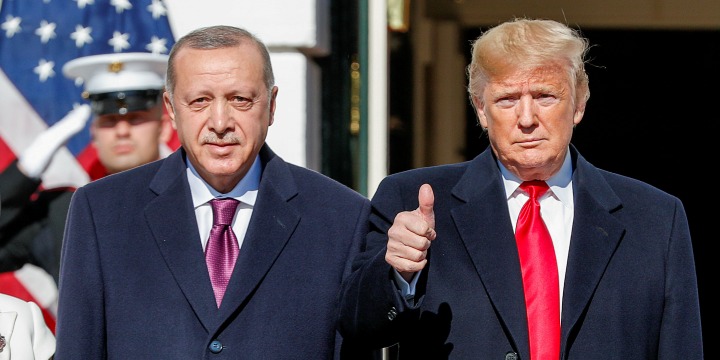
US President Donald Trump welcomes Turkish President Recep Tayyip Erdogan at the White House in Washington, DC, Nov. 13, 2019. Photo: Reuters / Tom Brenner.
The US political elite has long suffered from “Who lost that country?” syndrome. It started with the Truman administration, which failed to prevent the communist takeover of China in 1949. Then President Kennedy was blamed for the victory of Fidel Castro in Cuba in 1959. The Nixon administration saw the collapse of South Vietnam in 1975, and President Carter could not save the Shah from the Iranian revolution. Despite this historical background, many American policymakers — Republicans and Democrat alike — refuse to accept the obvious: Turkey is swinging away from the West. Here are five reasons why.
First, Turkey is changing fast. The Islamization of the country is a bottom-up rather than a top-down process. Anatolian Turks, who tend to be more conservative and religious, have higher birth rates than the Westernized Turks of Istanbul and the Aegean coast. Many now view Kemalist secularism as an imposed political and cultural order that ignores the country’s rich Islamic heritage.
Like other populist leaders, President Recep Tayyip Erdogan is keenly attuned to public sentiment. His anti-American, anti-European, and sometimes antisemitic rhetoric has made him popular among many religious Turks. After all, the country views itself as the successor of the Ottoman Empire. For five centuries, Istanbul was the seat of the Caliphate and the Ottoman Sultan was viewed as the leader of the Muslim world. Erdogan’s Turkey wants to play the same role, as can be seen in its support for the Muslim Brotherhood, Hamas, and other Islamist groups.
Second, the outbreak of the Syrian war has led to the dramatic revitalization of the Kurdish issue. In November 2013, the establishment of the Kurdish autonomous region of Rojava sent shock waves through Ankara. Turkey still suffers traumatic memories of the Treaty of Sèvres, which called for the formation of an independent Kurdistan. The new state would have been carved from the defeated Ottoman Empire.
Erdogan has often accused the US of supporting Kurdish nationalism and ignoring Turkish sensitivities on the issue, and the country’s media portrays the US as a backstabbing and arrogant ally. Ankara also suspects Israel of encouraging the Iraqi Kurds toward statehood. Turkish suspicions will only increase, as the West cannot abandon the Kurds. Being part of the West does not serve Turkish interests in Syria very well.
Third, the gradual withdrawal of the US from the Middle East and the subsequent return of Russia have changed regional security dynamics.
The Turkish leadership feels less obliged to follow a pro-Western course in the Trumpist world of tactical alignment and strategic uncertainty. Turkey now perceives itself as a rising power with a big economy (one of the top 20 in the world) and a strong military (the second-largest in NATO), one that is capable of fighting and winning wars. Indeed, Turkish armed forces have conducted successful combat operations in Iraq, Syria, and Libya without American backing.
Turkey’s growing confidence is also evident in its establishment of military bases in Qatar and Somalia, countries located far away. More importantly, its defense industry has grown considerably over the past five years and is now a multi-billion dollar high-tech sector of the economy. Erdogan’s Turkey has confidence — perhaps too much — in its ability to deal with external challenges.
Fourth, Turkey’s growing ties with Russia are neither tactical nor coincidental. Geopolitical considerations partly explain Turkey’s departure from its pro-Western orientation. Despite its spectacular return to the Middle East, Russia is destined to focus on the Arctic region. Due to climate change, Moscow does not need to have access to the warm sea of the Mediterranean. In fact, Putin has called the Arctic “the most important region that will provide for the future of Russia”. Nicholas Spykman’s Rimland (1942) and George Kennan’s Containment (1947) theories will become obsolete once the Arctic Ocean becomes navigable. Consequently, Ankara will have less to fear from Russia’s military might. Turkey’s membership in NATO could become irrelevant if not an obstacle to an even more revisionist foreign policy.
Fifth, Turkey is becoming an authoritarian country. Turkey has a long tradition of Westernization, but it is on a slippery slope where the rule of law is becoming increasingly problematic and the division of powers has grown blurry. After the failed coup of 2016, tens of thousands were imprisoned and even more lost their jobs in an endless political witch hunt. Moreover, Turkey is one of the world’s leading jailers of journalists, second only to China. Achieving membership in the EU is next to impossible. In an era when information flows online, NATO cannot long afford to ignore the human rights violations of its own members.
There should be no illusions. The West has diminishing influence over Turkey and must prepare for a worst-case scenario in which Turkey joins an anti-West alliance in the not-so-distant future. Fortunately, there are three countries in the Eastern Mediterranean that can function as a bastion of democracy and Western ideals: Greece, Israel, and the Republic of Cyprus are America’s best chance to maintain influence in the region.
Emmanuel Karagiannis is an Associate Professor in King’s College London’s Department of Defence Studies. He is author of The New Political Islam: Human Rights, Democracy and Justice (Philadelphia: University of Pennsylvania Press, 2018).
A version of this article was originally published by The BESA Center.