



Exhausted but Safe, 120 Jewish Orphans Fleeing Russian Invasion of Ukraine Arrive in Berlin
Error: Contact form not found.

 by Ben Cohen


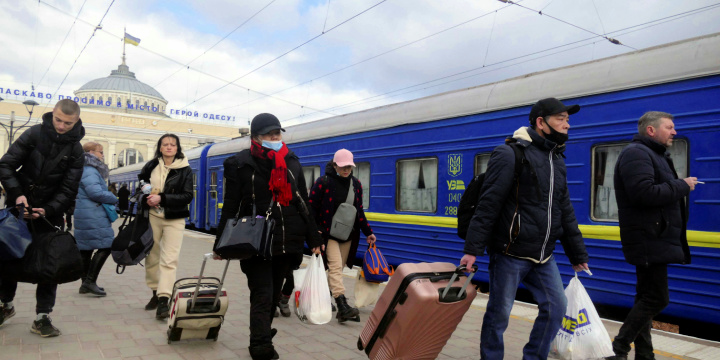
(Illustrative) Ukrainians in the city of Odessa boarding a train as they flee the Russian offensive. Photo: Reutewrs/Igor Tkachenko
A group of 120 exhausted Jewish orphans from the Ukrainian city of Odessa arrived in Berlin Friday morning, following an arduous journey through six countries on their way to Germany.
The children were brought to the German capital by the local arm of the Chabad religious movement. “We were able to secure accommodation for the first week and, thanks to the great help from the community, we were able to collect enough donations in kind,” Chabad Rabbi Yehuda Teichtal told the Juedische Allgemeine news outlet. “We welcomed the children with open arms.”
The children left their orphanages in the southern port city of Odessa on Wednesday, as residents and Ukrainian armed forces dug in for a renewed Russian military onslaught. The bus journey of more than 1,000 miles to Berlin took the group from Ukraine into Moldova, Hungary, Slovakia and the Czech Republic before arriving in Germany. The children will stay in a Berlin hotel until more permanent accommodation is found for them.
In a separate development, the head of Germany’s Jewish community said on Friday that agreement had been reached with the federal government to ease the immigration of Ukrainian Jews fleeing the Russian invasion.
Estimates by the Central Council of German Jews suggest that up to 5,000 Ukrainian Jews might immigrate to Germany under a new procedure that allows them to apply for immigrant status after arriving in the country.
“The suffering that people in Ukraine are currently experiencing is unbearable,” Josef Schuster, the council’s president, said on Friday. “It is all the more important that refugees are helped quickly now.”
In Ukraine itself, one of the heads of the Jewish community, Josef Zissels, said that preparations were now being made for extreme hardship brought on by the invasion — including the collapse of the banking system and lengthy electricity, telephone and internet outages.
In Moscow, meanwhile, Russia’s chief rabbi, who is close to Russian President Vladimir Putin, spoke out against the war in a statement that surprised some observers for its candor.
“Yes, we are different people, we can have completely different views on many problems,” Rabbi Berel Lazar wrote in a statement first circulated on Wednesday. “But we must agree on one thing: it is our duty before God to do our utmost to seek mutual understanding and respect, and by no means to lift the sword against our brother.”
Lazar added that he was “ready for any mediation, ready to do whatever I can and beyond to silence the guns and stop the bombing. But now is the time to act together.”