










‘Israel Is Too Complex to Be Reduced to a Tweet,’ Declares US Rep. Torres, Backing Its Approach to Russia-Ukraine War
Error: Contact form not found.

 by Sharon Wrobel

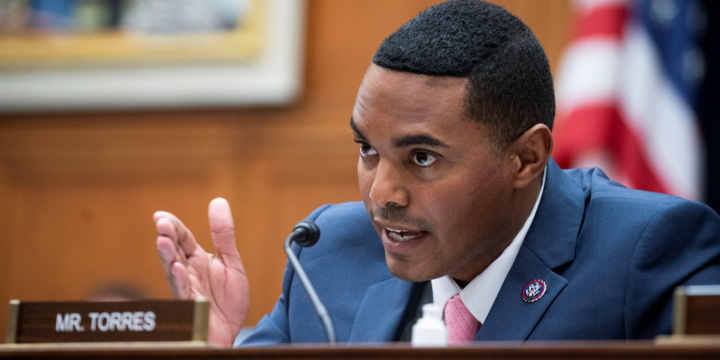
Representative Ritchie Torres speaks during the House Financial Services Committee hearing in Washington, U.S., September 30, 2021. Al Drago/Pool via REUTERS
As Israeli mediation efforts continued during the third week of Russia’s war in Ukraine, US Congressman Ritchie Torres (D-NY) suggested that the Jewish state could not afford to make an “enemy” of Moscow, in view of regional security challenges and Russia’s presence at the ongoing talks to revive the 2015 Iran nuclear deal.
“Israel has the delicate challenge of condemning the Russian invasion of Ukraine without antagonizing it at the expense of its own security,” Rep. Torres told The Algemeiner in an interview on Tuesday. “It’s a delicate challenge that that no one should envy.”
Recently returned from a delegation to Israel, the progressive Democrat representing New York’s 15th Congressional district responded to criticism that Israel has not gone far enough in joining Western actions to impose financial, diplomatic and military pressure on Russia.
Israel has provided aid to Ukraine and condemned the Russian invasion while resisting Kyiv’s requests for defensive weapons and other asks, and at times sounded a circumspect tone regarding the Kremlin — an approach Prime Minister Naftali Bennett has described as a “quiet” balancing of support for Ukraine with Israeli security interests. Most recently, Foreign Minister Yair Lapid announced Israel would not serve as a route to circumvent Western sanctions on Moscow.
“Unlike the United States, which is surrounded by two oceans and peaceful neighbors, Israel is heavily surrounded by hostility — whether it be Hamas in the Gaza Strip, or Hezbollah in Lebanon, or the Assad regime in Syria — and there is also Russia’s long-term presence in Syria,” Torres remarked. “My sense is that Israel is treading carefully because Russia is on its border. In life, you have to make enemies at a rate that you can absorb.”
Moscow’s presence in Syria’s skies has allowed the Israeli air force to wage an airstrike campaign against Hezbollah and other Iranian-backed groups active in weapons transfers there.
“Israel cannot prevent a terrorist organization like Hezbollah from entrenching itself in Syria without the cooperation of Russia,” Torres noted.
Torres believes that Israel is managing the precarious situation ably, while emerging as a mediator between Ukraine and Russia.
US Ambassador to Israel Tom Nides said Tuesday that the Biden administration is in “hourly contact” with Israel’s Naftali Bennett about his attempts to mediate, which if nothing else has helped keep communication lines open between Russian President Vladimir Putin and his Ukrainian counterpart Volodymyr Zelensky.
“We are very happy with the positions of the countries who are engaged, including Israel,” Nides said at a virtual event organized by Peace Now. “The Prime Minister has not made a move without talking to the White House. So we have no complaints with the Israelis.”
Nides acknowledged that Israel is in a somewhat of an “odd place” compared to many other countries, “given the fact that Russia is on the northern border, and they need Russia to help them deconflict as they go into Syria, to get the Hezbollah.”
Torres last month joined an AIPAC-led delegation of Democratic members of Congress on a visit to Israel. The group of lawmakers met with senior Israeli officials, including Bennett, Lapid and Defense Minister Benny Gantz to discuss the country’s security challenges, mainly Iranian aggression and the ongoing nuclear talks in Vienna, the threat from Hezbollah on the northern border, and Hamas.
Coming back from the trip, Torres said he was more worried about Israel’s security than he had been before, and called the threat of Hezbollah’s military capabilities “alarming.”
“My understanding is that Hezbollah has the capacity to easily fire 1,000 rockets in a single day. In a conflict with Hezbollah, there are not enough Iron Dome defense interceptors to interrupt every single attack,” Torres cautioned. “In that scenario, Israel would have no choice but to prioritize protecting critical infrastructure and make hard choices about where to strategically site interceptors.”
The 34-year-old Bronx, New York native noted that Hezbollah has over “200,000 missiles at its disposal — more missiles than every NATO country except the US combined.”
The congressional delegation also toured a Hezbollah cross-border attack tunnel on the northern frontier with the Lebanon, which took the Iran-backed terror group a decade to build and was exposed by Israel in 2018.
“I found it shocking that Hezbollah’s hate of Israel is so deep that it spent 10 years constructing a single tunnel,” Torres remarked. “My impassioned plea is that the critics in the US quick to pass the harshest judgement on Israel from the comfort of the American ivory tower should actually go to Israel and see the facts on the ground with their own eyes, and then come to their own conclusions — because you will find that the reality on the ground is far more complicated than the simplistic narrative circulating on social media.”
“Israel is far too complex to be reduced to a tweet,” he added.
Commenting on the ongoing efforts to finalize the reinstatement of the 2015 nuclear deal with Iran, known as the Joint Comprehensive Plan of Action (JCPOA), Torres spoke of a disconnect between perceptions of the agreement in the US and those in Israel, and the implications it could pose to the Jewish state’s security.
The JCPOA offered Iran significant sanctions relief in exchange for restrictions on its nuclear program, measures Israeli leaders and other critics said were insufficient.
“If we lift sanctions against Iran, and free up billions of dollars for the Iranian government, there’s every reason to think that those dollars would likely finance terrorism and proxy warfare at the expense of Israel and our allies in the region,” Torres asserted. “We should be deferential to those security concerns because Israelis are on the ground every day experiencing first-hand, state-sponsored terrorism on the part of Iran.”


