


Iran Attacks Israel: CNN Host Minimizes Barrage & Fake News Goes Viral
Error: Contact form not found.

 by Rachel O'Donoghue


An anti-missile system operates after Iran launched drones and missiles towards Israel, as seen from Ashkelon, Israel, April 14, 2024. Photo: REUTERS/Amir Cohen
Iran launched an unprecedented direct attack on Israel on Saturday, sending at least 300 drones and missiles towards the Jewish state.
The Israel Defense Forces (IDF) coordinated with other militaries, including the US and UK, to intercept most of the projectiles, which were also supplemented by further rockets fired from Iranian terror proxies in Iraq, Syria, and Yemen.
Iranian-backed Hezbollah also joined the assault, and announced that it had fired two barrages of rockets at an Israeli military base in the Golan Heights.
Hamas gained support for Oct 7 by inciting fear among Palestinians about Israel’s intentions for the Temple Mount.
Tonight, Israel protected their holy sites from missiles fired by Hamas’s patron Iran. pic.twitter.com/sluuiXgbzb
— HonestReporting (@HonestReporting) April 14, 2024
Fake News Goes Viral Overnight
As the skies above and surrounding Israel were lit up with rockets overnight, social media was also alight with fake news, videos, and photos purporting to be of the extraordinary attack.
While the majority of outright false information came from users on the platform X (formerly known as Twitter), Qatari mouthpiece Al Jazeera was also caught publishing a video that it falsely claimed showed rockets hitting Tel Aviv.
Meanwhile, infamous pro-Hamas influencer Jackson Hinkle was among the X platform users to share fake footage that he said showed “Israelis panicking” as the Iranian barrages hit Israel. BBC Verify journalist Shayan Sardarizadeh confirmed the video was actually of crowds in Argentina waiting to meet a musician.
This video, posted by Jackson Hinkle and others and viewed nearly 5 million times, claims to show “Israelis panicking” as Iran’s missiles and drones reach Israel.
in fact, it shows Louis Tomlinson fans near Four Seasons Hotel in Buenos Aires, Argentina last week; verified by… pic.twitter.com/11tX9bL0sh
— Shayan Sardarizadeh (@Shayan86) April 14, 2024
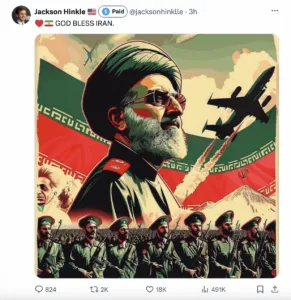
Hinkle, who was recently banned from Instagram, posted numerous messages of support for Iran throughout the attack, including several posts praising Iran’s Supreme Leader Ayatollah Ali Khamenei and AI-generated images of planes dropping bombs.
Unsurprisingly, Iran’s state TV was behind the spread of many videos that purported to show catastrophic damage in Israel, including one that was actually of a fire in Chile that was filmed in February.
On the left: Iranian state media claiming this is footage from an Iranian missile which hit Israel.
On the right: the same footage from a fire in Chile in February.
𝐑𝐞𝐦𝐢𝐧𝐝𝐞𝐫 𝐭𝐨 𝐭𝐡𝐞 𝐈𝐫𝐚𝐧𝐢𝐚𝐧 𝐑𝐞𝐠𝐢𝐦𝐞: our defense systems intercepted 99% of their missiles. pic.twitter.com/xpLXGO3qd0
— Israel ישראל 🇮🇱 (@Israel) April 14, 2024
Perhaps hoping to ratchet up the tension, a number of users shared claims that Israel had immediately launched a drone counterstrike on Iran, including sharing videos of what they claimed was a fire in Tehran.
Others shared footage of the 2020 Beirut Port explosion, which they said showed Israel’s Mossad bombing the Iranian capital.
BREAKING: A massive drone strike has occurred in Iran’s capital, Tehran. The Israeli Mossad has already claimed responsibility for it. pic.twitter.com/Q9VdxI6heV
— GSPs Backup (@ConLibCon) April 13, 2024
The international media responded to the overnight attack with breaking news updates and rolling live coverage.
While most of the reporting stuck to the facts, there were a few instances of the media either downplaying the attack or obscuring the sequence of events that preceded Iran’s assault.
CNN pundit Christiane Amanpour, for example, ludicrously described the attack as “entirely targeted,” even though hundreds of thousands of Israelis were forced into shelters as large parts of the country remained under threat.
“It seems to be entirely targeted; it wasn’t an attack directed at the whole of Israel.”@amanpour, try telling that to the hundreds of thousands of Israelis who were forced into bomb shelters or the 7-year-old girl critically injured by shrapnel to her head. pic.twitter.com/XtZaPY8zmR
— HonestReporting (@HonestReporting) April 14, 2024
The BBC and ABC News Australia did not specify in their headlines that Iran had fired hundreds of drones and long-range missiles at Israel, instead vaguely referring to the weapons as “objects.” Furthermore, ABC News Australia’s headline failed to mention Iran at all.
“Objects.”
Well done, @BBCNews. 🤦♂️https://t.co/289O02VZRl pic.twitter.com/oo16CLpxk4
— HonestReporting (@HonestReporting) April 14, 2024
The New York Times, in its coverage, suggested that the attack was somehow justified by asserting that Israel had “bombed an Iranian embassy complex” in Damascus. In reality, Israel targeted a building near the embassy that was being used by Iranian Revolutionary Guards Corp (IRGC) leaders to coordinate attacks on Israel.
The Observer published an editorial mere hours after the attack, calling for any further escalation to be prevented:
Amid the present tumult, it should not be forgotten that this Iranian attack was provoked, according to Iran’s leadership at least, by Israel’s unacknowledged bombing on 1 April of an Iranian embassy annex in Damascus that killed several senior commanders. In Tehran’s not unreasonable view, that attack crossed a red line by targeting diplomatic premises.” [emphasis added]
Let us be completely clear: there is nothing “unreasonable,” as The Observer suggests, about Israel striking the infrastructure of the world’s biggest state sponsor of terrorism that was being used to mastermind attacks on Israel. Suggesting it was merely a diplomatic facility is nothing short of absurd.
According to @ObserverUK, “this Iranian attack was provoked, according to Iran’s leadership at least, by Israel’s unacknowledged bombing on 1 April of an Iranian embassy annex in Damascus that killed several senior commanders. In Tehran’s not unreasonable view, that attack… pic.twitter.com/sXidFByZTZ
— HonestReporting (@HonestReporting) April 14, 2024
The author is a contributor to HonestReporting, a Jerusalem-based media watchdog with a focus on antisemitism and anti-Israel bias — where a version of this article first appeared.