







New York Times Blames Israel for West Bank Economic Misery, Omitting Crucial Context
Error: Contact form not found.

 by Ira Stoll

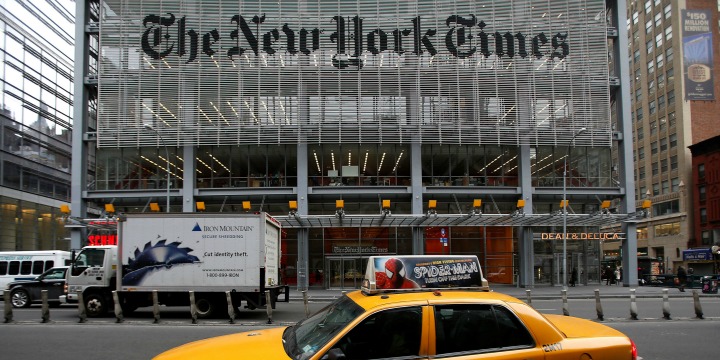
A taxi passes by in front of The New York Times head office, Feb. 7, 2013. Photo: Reuters / Carlo Allegri / File.
A front-page article in Sunday’s New York Times carried the online headline “Away from the War in Gaza, Another Palestinian Economy Is Wrecked.” It blamed Israel for ruining the livelihoods of West Bank Palestinians by curbing payments from the Israeli government to the Palestinian Authority (PA).
“In a recent report, the World Bank said that the authority’s financial health ‘has dramatically worsened in the last three months, significantly raising the risk of a fiscal collapse.’ It cited the ‘drastic reduction’ in tax transfers from Israel and ‘a massive drop in economic activity,'” the Times reported.
The Times referred to “measures to starve the Palestinian Authority of funds, pushed by far-right members of the Israeli government who want to annex the West Bank and resettle Gaza.” The newspaper said the measures “have alarmed the Biden administration,” whose officials “worry that an economic crash in the West Bank could lead to more violence.”
What the Times article omitted is that American and Israeli law restricts payments to the PA if it pays terrorists or their survivors for their acts against Israelis.
After Oct. 7, 2023, the Palestinian Authority stepped up payments to the families of hundreds of new “martyrs” and recognized thousands of new prisoners, detained terrorism suspects who are also eligible for payments from the PA. Itamar Marcus and Ephraim Tepler of the watchdog group Palestinian Media Watch, citing figures from the official Palestinian Authority news service WAFA, conservatively estimate the prisoner payments at about $16.4 million a month and the martyr payments at about $15 million a month. Martyrs also get a one-time reward or bonus payment. According to Marcus and Tepler, PA civil servants are getting by on 50 percent of their salaries, while the imprisoned terrorists are getting paid at the full rate.
In 2018, PA President Mahmoud Abbas said he’d prioritize the martyr and prisoner payments above any other expenditure. “Even if we have only a penny left, we will give it to the martyrs, the prisoners, and their families,” he said then. “We view the prisoners and the martyrs as planets and stars in the skies of the Palestinian struggle, and they have priority in everything.”
While polling in unfree areas isn’t always reliable, a survey from March 2024 indicated that 71 percent of West Bank Palestinians support the Oct. 7 attack on Israel, about the same level as Gaza Palestinians. Sixty-four percent of the West Bank Palestinians said they prefer Hamas to remain in control of Gaza.
Because the Times omitted the explanation for the withheld funds, the article made it sound like the Israelis were being cruel, vindictive, or, as the phrase “far-right,” suggested, extremist. It made it sound like those far-right Israelis were to blame for the Palestinians’ economic plight. Absent from the article was any suggestion that the Palestinians themselves could turn the situation around by making different decisions about prioritizing martyr payments and prisoner salaries.
It’s not clear why the Times didn’t mention any of this. The article did give a hint when it mentioned one source who “praises the Palestinian security forces, two of whose commanders were in the room monitoring the interview.”” The Times reporter, Steven Erlanger, who once, while a Boston Globe reporter, survived being shot, is not easily intimidated. But you kind of wonder why he didn’t interview the Palestinian security forces about whether they were getting paid in full, and whether they agree that they should take a back seat to martyrs and prisoners in the Palestinian Authority payroll prioritization scheme. Imagine how good an economy the Palestinians could have if they spent the money on education and economic development rather than corruption and subsidies for terrorists.
The Times article described Palestinians having a hard economic time. There are also plenty of Israelis, both Arabs and Jews, having a hard economic time because of the war. This Times article didn’t mention them. The underlying and unstated assumption of the Times has been that Palestinian Arab support for terrorism should be consequence-free for the Palestinian Arabs.
It’s a complicated situation, because economic suffering in the West Bank can hurt even those Palestinian Arabs who oppose Hamas and favor peace with Israel. If there’s a hope for peace, though, it’s in the idea that the Palestinians might eventually figure out that eradicating the terrorists, rather than subsidizing them, is the best path out of misery and toward prosperity. For the Palestinians’ sake, for Israel’s sake, and for America’s sake, I hope the Palestinians do eventually come to that realization. It might well involve their having to read some newspaper other than The New York Times.
Ira Stoll was managing editor of The Forward and North American editor of The Jerusalem Post. His media critique, a regular Algemeiner feature, can be found here.


