









After the Recent War with Iran, Should Israel’s Bomb Stay ‘In the Basement’?
Error: Contact form not found.

 by Louis René Beres

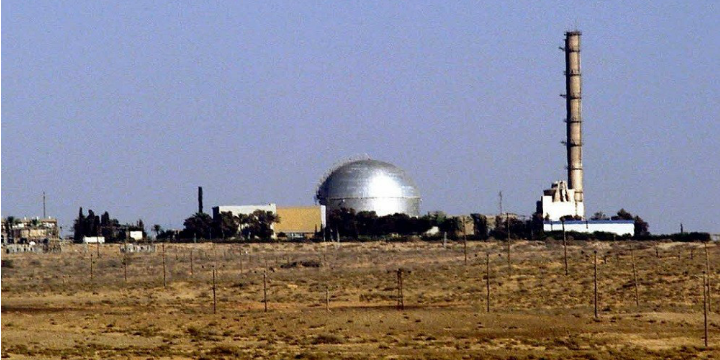
Israel’s nuclear reactor near Dimona. Photo: Wikicommons
In war, short-term operational success does not necessarily support long-term survival outcomes.
Despite achieving its immediate goals during the “Twelve-Day War,” Israel will still have to make substantial deterrence policy modifications. Potentially, the Jewish State, smaller than America’s Lake Michigan, now faces greater perils than before the latest war.
How can this be possible? Didn’t the combined effects of Israeli and American bombings “obliterate” Iran’s nuclear military threat?
There is a succinct answer. Though this threat has been degraded, it has not been removed. In assorted increments, Iran could return to where it was before the war, and then advance further in tangibly quantum leaps. At some stage, already-nuclear state allies of Iran could agree to function as Tehran’s nuclear surrogate. Here, both North Korea and Pakistan should come quickly to mind.
What is Israel’s most immediate task? Above all, Jerusalem should do whatever is needed to upgrade and enhance its nuclear deterrence posture. This posture, which includes both doctrine and strategy, will depend on Israel’s decipherable willingness to replace “deliberate nuclear ambiguity” with “selective nuclear disclosure.”
It’s not just about reaffirming the obvious. Controlled nuclear disclosure will be needed to assure Iran and other adversaries (nuclear and non-nuclear) that Israel’s ordnance would be available at all levels of foreseeable military conflict.
This means that Jerusalem will need to make less ambiguous that its presumed nuclear weapons are seemingly “usable” — that is, not too-destructive. Though counter-intuitive and misunderstood, viable nuclear deterrence requires weapons that are recognizably amenable to situational adjustments and calibrations.
Even after Israel’s recent victories over Iran, it would be unreasonable to assume that “deliberate nuclear ambiguity” could work indefinitely.
Even if Iran’s nuclear potentialities were meaningfully set back by “twelve-day war” bombardments, there would remain other worrisome enemy states. After the just-halted conflict, Pakistan reaffirmed “complete solidarity” with Iran. This declaration included explicit threats of direct nuclear retaliation against Israel if Iran were to face an Israeli nuclear attack. For example, nuclear North Korea has a history of belligerent interactions with Israel and could conceivably serve Iran as a fearsome nuclear proxy.
How do matters stand right now? Using Reason as decisional criterion, Israel will need to update its national strategic posture by shifting from “deliberate nuclear ambiguity” to “selective nuclear disclosure.”
If Israel remained committed to its “bomb in the basement” nuclear posture, the country’s intra-war opportunities to achieve “escalation dominance” would be severely limited. Even if Tehran were to accept the “usability” of Israel’s nuclear options, it might still not believe that Jerusalem would be willing to exercise these options. As a result, a tit-for-tat dynamic of conventional warfare could proceed unabated and Israel might have to face the exhausting prospect of seemingly interminable attrition warfare.
Iran is planning to buy Chinese Chengdu J-10C fighter jets compatible with PL-15 missiles, the same ordnance used by Pakistan’s air force. China already assists Iran by buying its oil, a vast benefit to Tehran that could accelerate resumed efforts to acquire nuclear weapons. Less directly, any planned US sale of F-35 stealth fighter jets to Turkey could offer multiple military benefits to Iran.
In essence, Israel cannot rely indefinitely on an implicit nuclear deterrence posture. Regarding any future or impending war with Iran, Israel needs to consider once-speculative but no longer unrealistic scenarios. Among the narrative possibilities, Pakistan and/or North Korea could sometime become actual nuclear proxies for a still non-nuclear Iran. At that point, any Israeli continuance of “deliberate nuclear ambiguity” would be manifestly irrational.
Israel needs to ensure “escalation dominance” in all plausible conflict scenarios. Inter alia, this will mean keeping Iran non-nuclear. Although there will be many technical questions about optimal levels and times of “selective nuclear disclosure,” this is not yet the moment for raising such queries.
There is more. Even a pre-nuclear Iran could make combat use of radiation dispersal weapons and/or conventional missiles/drones launched against Israel’s Dimona nuclear reactor. In a worst case scenario, Iranian ally North Korea would place nuclear assets at Tehran’s operational disposal. Pyongyang, it should be recalled, built a nuclear reactor for Syria that was destroyed by Israel’s Operation Orchard on September 6, 2007.
While it is doubtful that “selective nuclear disclosure” would end Iran’s belligerent designs against Israel, a more selectively-explicit Israeli deterrence posture represents Jerusalem’s only rational choice. At the same time, even this enhanced doctrine and strategy might not be enough. It follows that Jerusalem, with or without its American ally, could sometime still need to launch new rounds of measured preemptive strikes.
There is one final observation. The prevailing “mood” in Israel seems opposed to taking the “bomb” out of the “basement.” Though such wariness is understandable (“why stir the pot if deterrence is already working”), it fails to take account of changing enemy intentions and capabilities. Moreover, the expected benefits to Israel of strategic changes to “deliberate nuclear ambiguity” would outweigh the expected costs of pressures to join the Non-Proliferation Treaty (NPT).
Prof. Louis René Beres was educated at Princeton (Ph.D., 1971) and is the author of many books and scholarly articles dealing with international law, nuclear strategy, nuclear war, and terrorism. In Israel, Prof. Beres was Chair of Project Daniel (PM Sharon). His 12th and latest book is Surviving Amid Chaos: Israel’s Nuclear Strategy (Rowman & Littlefield, 2016; 2nd ed., 2018).