









Canada’s Residential Schools and the Mistreatment of Jewish Children in Russia and Yemen
Error: Contact form not found.

 by Jacob Sivak

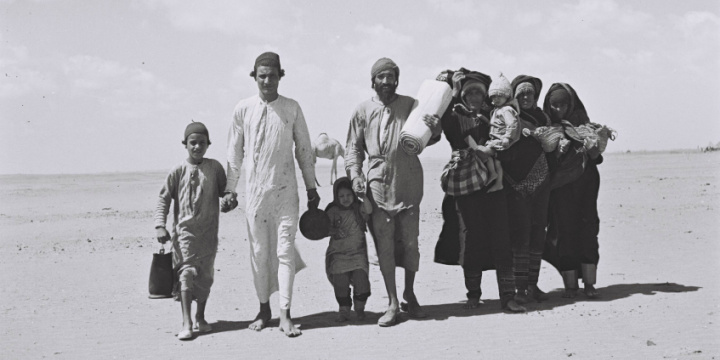
Yemenite Jews walking through a desert, near Aden, before being airlifted to Israel, November 1949. Photo: Wikimedia Commons.
September 30 marked Truth and Reconciliation Day in Canada, a reminder that for more than a century, an estimated 150,000 aboriginal (First Nations, Métis, and Inuit) children were removed from their homes and placed in distant church-run residential Schools, where they were denied access to their language and culture.
This is not ancient history. The last Residential School closed in 1997.
In addition, from the 1950s to the 1980s, approximately 20,000 aboriginal children in Canada were scooped (the “Sixties Scoop”) from their homes by provincial welfare authorities and placed for adoption in non-indigenous homes in North America.
Jews have also experienced the forced assimilation of children in relatively recent times. The Jewish Cantonists (underage soldiers) in Russia during the 1800s come to mind.
Young Jewish boys, as young as seven or eight, were grabbed (in Yiddish, khapped), and taken to government schools (cantons) to be educated in isolation of their culture and religion. At 18 years of age, they entered 25 years of service in the Tsar’s army. An estimated 30 to 40,000 Jewish boys were taken from their homes and people (Yehuda Slutsky, Encyclopedia Judaica, 2006). Few returned.
A more recent history involves the Jews of Yemen, the subject matter of Ayelet Tsabari’s 2024 novel, Songs for the Brokenhearted. Tsabari’s book is well worth reading, both as a novel and for its historical value.
The plot line of the novel involves two alternating periods: The early 1950s, right after the vast majority of the Jews of Yemen were air-lifted to Israel (Operation Magic Carpet), and later, in 1995, when the protagonist, Zohara, a PhD student in the US, returns to Israel after a failed marriage to be at her mother’s funeral.
In cleaning her mother’s home, Zohara discovers a trove of audio tapes containing songs, including love songs, created and sung by her illiterate mother, Saida. This, she learns, is in keeping with a centuries-old oral tradition by which Jewish women communicated their feelings and thoughts.
A newspaper photograph (spoiler alert) in her mother’s wallet is the springboard to another surprise — her mother’s secret romance with a young Yemeni Jew she met in one of the rudimentary absorption camps (Ma’abarot) that were a common feature of the Israeli landscape during the 1950s. The problem for the couple was that Saida was already married. Polygamy was not unheard of among Yemeni Jews at that time, and Saida was a second wife.
For centuries, Jews in Yemen were subject to the Orphans Decree, mandating the forced conversion to Islam of abducted Jewish orphans. There was a hiatus of a few decades in the late 1800s, when Yemen came under Ottoman control, but the edict was enforced again after World War I. One way around the decree was to arrange marriages for the orphans when they were young, in order to give them legal status as adults. That is how Saida became a second wife.
The novel raises another tragic story involving children who were placed in nurseries away from their families because of unsanitary conditions in the Ma’aborot. Some parents, checking on their children, were told their previously healthy child had taken ill and died in hospital. Where were the death certificates or graves? It was widely rumored that the children, some say thousands, were adopted by Ashkenazi (European) couples.
This is the narrative believed, even today, by many Israelis. Yet three government judicial inquiries and the 2016 publication of 400,000 related documents, indicate that it is not true (Yaakov Lozowick Tablet Magazine, 2019, and Ben Rothke, The Lehrhaus, 2025).
While the documents do show that hundreds of infants from Yemeni families died from disease, there are no documents indicating a trail of adoption, or a nefarious government scheme.
The evidence does show that newly arrived Yemeni families were treated with neglect and little understanding by the various Israeli bureaucracies they encountered, particularly the health care system. Prejudice by the dominant Ashkenazi establishment toward the less educated Jews from Yemen played a large role.
Ayelet Tsabari is an Israeli of Yemeni descent who lived in Canada from 1998 to 2018, when she returned to Israel. Given her background, it is not surprising that she wove this episode into her book.
Of the many Jewish communities that once existed in the Muslim world, the “dhimmi” conditions imposed on the Jews of Yemen were the harshest (The Siege, Conor Cruise O’Brien, 1988). Yet, they never lost their dream of returning to Zion. Equally important, the Orphans Decree was the primary push leading to the mass exodus of virtually the entire Yemeni Jewish community to Israel right after the establishment of the state.
Among the accusations cast at Israelis and Jews, especially since October 7, is the claim that Israel is a colonial enterprise, no different from the colonization of the Americas by Europeans.
This is wrong.
The Jewish people have had a continuous presence in the Land of Israel, and in the Middle East, and half the Jews in Israel today are not European in origin. They (or their relatives) fled the Muslim world after 1948.
Jacob Sivak, a Fellow of the Royal Society of Canada, is a retired professor, University of Waterloo.