

Israel Ramps Up Lebanon Offensive as Hezbollah Morale Reportedly Crumbles
Error: Contact form not found.

 by Ailin Vilches Arguello


Smoke billows following an Israeli strike in Nabatieh, Lebanon, May 26, 2026. Photo: REUTERS/Stringer
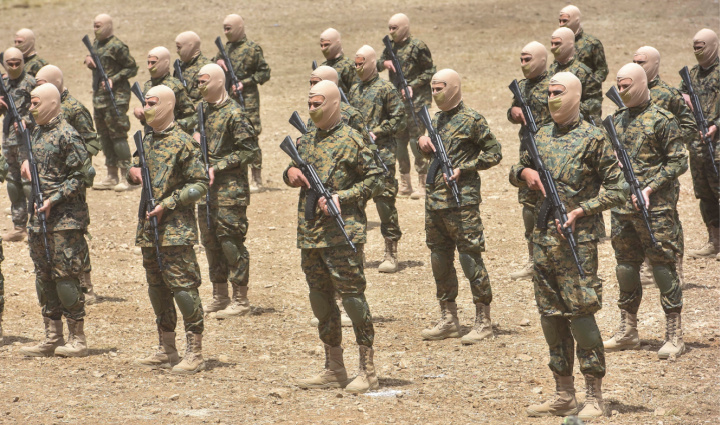
Israeli forces have expanded ground operations across southern Lebanon this week, with reports pointing to weakening morale within Hezbollah’s ranks and growing uncertainty over the Iran-backed Lebanese terrorist group’s cohesion under growing pressure.
According to the Israeli news outlet Walla, a senior military official said Beirut is no longer considered off-limits for Israeli operations after repeated ceasefire violations by Hezbollah, adding that the military would take advantage of any operational opportunity to strike Hezbollah targets in the Lebanese capital.
After Washington requested that Israel refrain from strikes in Beirut to keep ceasefire negotiations with the Lebanese government viable, Israeli officials have repeatedly argued that continued restraint toward Hezbollah will erode operational gains achieved in recent months.
Now, the Israeli government has reportedly “released the reins,” granting the Israel Defense Forces (IDF) broad operational freedom against the Iranian proxy as tensions along the northern front continue to escalate.
Israeli Prime Minister Benjamin Netanyahu announced Tuesday that Israel was “intensifying its operations” against Hezbollah, ordering military commanders to “press the pedal even harder” in response to the Islamist group’s continued attacks.
“The Israeli army is operating with significant forces on the ground and has taken control of strategically important positions,” the Israeli leader said, adding that Jerusalem is working to reinforce a buffer zone “to safeguard towns in northern Israel.”
“We now need to increase the blows and the intensity of our response,” he continued. “We will strike them hard, hip and thigh.”
IDF Chief of Staff Lt. Gen. Eyal Zamir has already approved a large-scale operational plan targeting senior Hezbollah figures, field commanders, weapons stockpiles, and operatives involved in the group’s drone warfare network.
Israeli officials have warned that any further violation of the ceasefire agreement reached last month will be met with a severe response, stressing that continued breaches would prompt a markedly escalated military effort with little tolerance for further restraint.
With Israel already maintaining broad operational control across southern Lebanon, reports indicate emerging signs of weakening morale within Hezbollah’s ranks as pressure on the group intensifies.
In recent weeks, security assessments have indicated extensive Israeli firepower, artillery, and air superiority along the Nabatieh and Tyre axes — key inland and coastal routes in the south of the country — effectively transforming much of the area south of the Litani River into an active operational theater.
In one of the heaviest nights of strikes in weeks, the IDF carried out more than 120 airstrikes overnight Tuesday, hitting over 100 Hezbollah targets in southern Lebanon and the eastern Bekaa Valley, including storage facilities, command centers, and observation posts used in attacks against Israeli troops and communities in northern Israel.
If Israel reaches and strikes Nabatiya — one of Hezbollah’s most important symbolic and social strongholds — it would deliver a major psychological blow that could further weaken morale within the group and erode confidence among its supporters.
As Israel intensifies pressure on Hezbollah across multiple fronts, growing reports of exhaustion, fear, and deteriorating morale within the group’s ranks are beginning to expose the mounting strain of the prolonged conflict.
“We hide along roadsides beneath the trees, without phones. Every few hours, a car passes by, tossing food to us through the window before disappearing again. If the leadership needs us elsewhere, the driver stops under the trees and calls us by name,” one of the group’s fighters told the Arabic newspaper Nidaa Al-Watan in an exclusive interview.
“We survive in forests and valleys, never knowing when death will come, yet we have no way out. If we try to flee, we will be killed by our comrades and labeled as ‘martyrs’ in the fight against Israel. Either way, we are simply waiting for death — there is no other choice,” he continued.
Last week, Israeli and Lebanese officials held a third round of talks in Washington aimed at advancing the negotiations, even as Hezbollah continued to reject disarmament and oppose any potential peace deal.
Inside Lebanon, fears are mounting that Hezbollah could trigger a new wave of political violence and destabilization as pressure intensifies to dismantle the Iran-backed terrorist group’s military grip.
Lebanese officials have reiterated that the decision to establish a state monopoly over weapons is final, though its implementation remains contingent on reaching a broader security arrangement with Israel under US guarantees.
The Iranian proxy has accused Lebanese President Joseph Aoun and Prime Minister Nawaf Salam of betraying the “resistance” and collaborating with Israel amid ongoing direct bilateral negotiations, branding them “traitors” aligned with foreign interests.
The terrorist group has repeatedly defied international calls to disarm, even threatening protests and civil unrest if the government tries to enforce control over its weapons.
Hostilities between Hezbollah and Israel reignited on March 2, when the terrorist group opened fire in support of Iran two days after the start of the joint US-Israeli military campaign against the Iranian regime.
Since then, Israeli forces have established a buffer zone extending into southern Lebanese territory, which officials say is meant to shield northern residents from Hezbollah attacks amid thousands of rockets and drones fired throughout the war.
Even though a US-backed ceasefire has sharply reduced violence, negotiations and prospects for lasting peace remain fragile, with Israeli forces still launching strikes while positioned in southern Lebanon to maintain its buffer zone and dismantle Hezbollah military infrastructure.