






US Envoy Sees Israel Keeping Golan Heights Forever
Error: Contact form not found.

 by Reuters and Algemeiner Staff

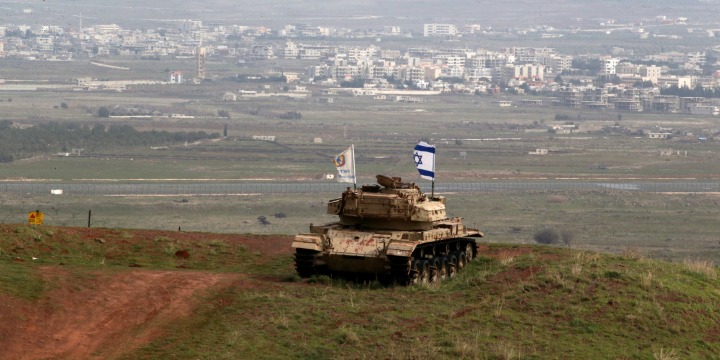
An old military vehicle positioned on the Israeli side of the border with Syria, near the Druze village of Majdal Shams, in the Golan Heights, Feb. 11, 2018. Photo: Reuters / Ammar Awad.
The US ambassador to Israel said in remarks published on Thursday he expected Israel to keep the Golan Heights in perpetuity, in an apparent nod towards its claim of sovereignty over the strategic plateau captured from Syria in the 1967 Six-Day War.
Foreign governments, including the United States, do not recognize Israel‘s claim and President Donald Trump’s national security adviser has said Washington’s policy is unchanged.
However, US Ambassador David Friedman suggested Israel was there to stay and said it was possible the United States would consider recognizing Israeli sovereignty over the Golan Heights in the future.
“I personally cannot imagine a situation in which the Golan Heights will be returned to Syria. I frankly cannot imagine a situation in which the Golan Heights is not part of Israel forever,” he told the Israel Hayom newspaper.
Friedman said there was “no one more undeserving of this prize” — control of the Golan Heights — than Syrian President Bashar al-Assad.
Since early in Trump’s term, Israel has lobbied for formal US endorsement of its control of the Golan. Trump has recognized Jerusalem as Israel‘s capital, breaking with other world powers, but National Security Adviser John Bolton said last month a similar Golan move was not under discussion.
In the past year and a half, Trump has twice ordered US-led air strikes against targets in Syria in response to what Washington called the Assad government’s use of chemical weapons against civilians.
“Relinquishing the high ground of the Golan Heights could put Israel at a great security disadvantage,” Friedman said.
The Golan Heights form a buffer between Israel and Syria of about 1,200 square kilometers (460 square miles).
Israel took control of most of it from Syria in 1967, and annexed the territory in 1981.
Once willing to consider returning the Golan for peace with Syria, the Israelis have argued in recent years that the civil war in Syria and the presence there of an Iranian garrison backing Damascus show they need to keep it.
Interviewed by Reuters last month, Bolton said: “Obviously we understand the Israeli claim that it has annexed the Golan Heights — we understand their position — but there’s no change in the US position for now.”
Responding to those remarks, Israeli Prime Minister Benjamin Netanyahu said there “no way” he would give up to trying to win US recognition.
Asked, in light of Bolton’s comments, whether it was possible the Trump administration would consider at a future date recognizing Israeli sovereignty, Friedman said: “Yes, that’s definitely possible. It definitely could happen.”


