




As Renewed US Sanctions Hit, Iranian Regime Test-Fires Missiles in Major Military Exercise Led by IRGC
Error: Contact form not found.

 by Algemeiner Staff

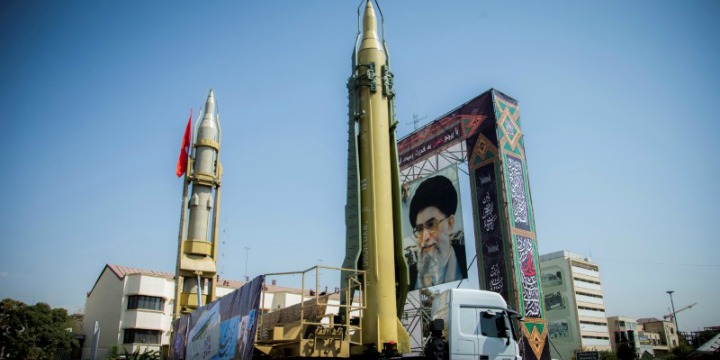
A display featuring missiles and a portrait of Iranian Ayatollah Ali Khamenei is seen at Baharestan Square in Tehran, Sept. 27, 2017. Photo: Nazanin Tabatabaee Yazdi / TIMA via Reuters.
The Iranian regime responded to the tough new sanctions reinstated by the Trump administration on Monday by reportedly test-firing three to surface-to-air missiles as part of a large-scale military exercise.
On Monday, the regime’s mouthpiece Tasnim News Agency carried a series of undated photographs of missiles being fired, along with the news that troops from Iran’s regular forces and the Islamic Revolutionary Guards Corps (IRGC) — Iran’s powerful elite military unit — had carried out joint drills over an area of approximately 194,000 square miles in the central and western parts of the Islamic Republic.
“During the ‘Velayat’ air defense drill, the Army fired three ‘Sayyad-2’ missiles paired with the ‘Talash’ homegrown missile system,” Tasnim reported.
“The homegrown Talash air defense system can hit medium and high-altitude targets,” Tasnim boasted. “Capable of intercepting targets within a range of 150 kilometers and in high altitudes, Talash has been equipped with a locally-manufactured fire control radar, dubbed Ofoq.”
The agency added that in another operation during the same joint exercise, “IRGC Aerospace Force units employed ‘Khordad 3rd’ air defense missile system to shoot down dummy hostile aircraft over the sky of the drill zone.”
It further claimed that “Khordad 3rd enjoys state-of-the-art technologies suitable for electronic warfare. It can intercept 4 targets and fire 8 missiles simultaneously within a range of 50 km.”
Tasnim asserted that the purpose of the exercise was purely defensive, with the primary aim of improving Iran’s “command and control systems to detect, track and intercept hostile targets.”
First unveiled in November 2013, the Sayyad-2 is an adaptation of the SM-1 missile used by the Iranian navy. A correspondent for specialist defense outlet Janes‘ noted at the time of the missile’s unveiling in Tehran that the Sayyad-2 was “fired from individual canisters that are similar to those used by the MIM-104 Patriot air defense system” — an anti-ballistic missile currently used by the United States and several of its allies.


