





Trump Is the Candidate for the Middle East
Error: Contact form not found.

 by Eyal Zisser / Israel Hayom / JNS.org

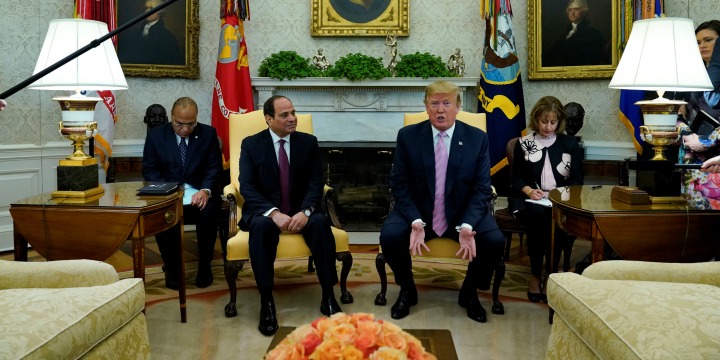
US President Donald Trump meets with Egypt’s President Abdel Fattah Al Sisi in the Oval Office at the White House in Washington, US, April 9, 2019. Photo: REUTERS/Kevin Lamarque/File Photo.
JNS.org – The 2020 US presidential election is in the final stretch, and Iran cannot seem to stand the suspense. Last week, Washington detected attempts by Tehran to influence the election.
Iran has made no secret of its desire to see Trump out of the White House — and for good reason. His administration has worked tirelessly to reimpose sanctions over Iran’s nuclear program, and has taken other far-reaching steps to put Tehran on the defensive. These efforts have set Iran’s aspirations of regional hegemony back years. Is it any wonder the ayatollahs are losing sleep over the possibility of four more years?
Here, too, Iran is the exception to the rule. Most Middle East countries want to see Trump remain in the White House; the fact that Iran fears him so much is considered a bonus. One can argue about his style, but no one can deny Trump credit for the fact that his regional policies have made friends and foes alike take notice. He has restored the United States’ standing as a major power-player in the Middle East.
There is also no doubt that his crowning achievement is making actual breakthroughs in the moribund Middle East peace process. His decision to go over the Palestinian Authority’s head was proven right, and regardless of what the future might bring, Trump will go down in history as the US president who brokered three peace agreements between Muslim nations — the United Arab Emirates, Bahrain, and Sudan — and the Jewish state, and presided over the Israel-Lebanon maritime border talks. And more is sure to come.
Effective progress in peacemaking in the Middle East alongside the very effective deterrence gained vis-à-vis Iran has restored stability to the Middle East in the wake of the Arab Spring, and therefore has been welcomed by the region’s rulers. Trump has proven he has a better understanding of regional realities than his predecessor, and unlike President Barack Obama didn’t create an Islamist backlash by trying to push Western democracy or preach morals.
The results of the November 3 elections are for American voters to decide, but Trump’s legacy will be felt in the Middle East long after he leaves the White House, be it in 2020 or in 2024. His will be a legacy of power and determination, of resorting stability to the region, and of proving that the United States stands by its allies.
Eyal Zisser is a lecturer in the Middle East History Department at Tel Aviv University. This article first appeared in Israel Hayom.


