




Erdogan Says Turkey Would Like Better Ties With Israel, Criticizes Policy Toward Palestinians
Error: Contact form not found.

 by Reuters and Algemeiner Staff

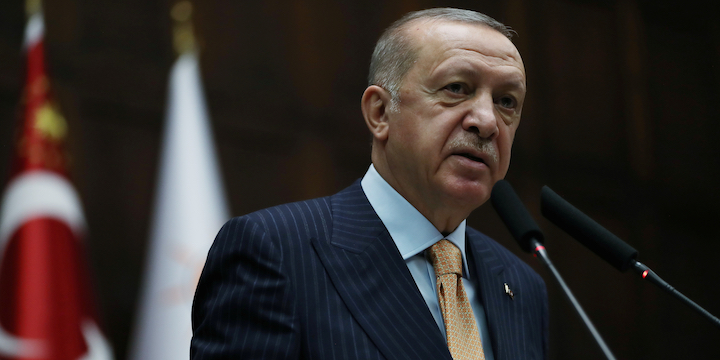
Turkish President Recep Tayyip Erdogan addresses members of his ruling AK Party (AKP), during a meeting at the Parliament in Ankara, Turkey, Oct. 28, 2020. Photo: Murat Cetinmuhurdar / Presidential Press Office / Handout via Reuters.
President Tayyip Erdogan said that Turkey would like to have better ties with Israel, but criticized Israeli policy toward Palestinians as “unacceptable” and a “red line” for Ankara, adding that intelligence talks resumed between the two sides.
The two countries have had a bitter falling out in recent years, despite strong commercial ties, expelling ambassadors in 2018. Ankara has repeatedly condemned Israel’s presence in the West Bank and its approach to the Palestinians.
Speaking to reporters after Friday prayers in Istanbul, Erdogan said Turkey had issues with “people at the top level” in Israel and that ties could have been “very different” if it were not for those issues.
“The Palestine policy is our red line. It is impossible for us to accept Israel’s Palestine policies. Their merciless acts there are unacceptable,” Erdogan asserted.
“If there were no issues at the top level, our ties could have been very different,” he added. “We would like to bring our ties to a better point.”
Turkey and Israel, former allies, expelled each other’s top diplomats in 2018 over clashes when dozens of rioting Palestinians were killed by Israeli forces on the Gaza border. Ankara and Tel Aviv continue to trade with one another.
In August, Israel accused Turkey of giving passports to a dozen Hamas members in Istanbul, describing the move as “a very unfriendly step” which the government would raise with Turkish officials.
Hamas seized Gaza from forces loyal to Palestinian President Mahmoud Abbas in 2007, and the terror group has fought three wars with Israel since then. Turkey says Hamas is a legitimate political movement that was elected democratically.
Israel, which has formalized ties with four Muslim countries this year, said on Wednesday it was working towards normalizing ties with a fifth Muslim nation, possibly in Asia. Tunisia said on Tuesday it did not intend to normalize ties.
Ankara has slammed the US-brokered rapprochements between Israel and the United Arab Emirates, Bahrain, Sudan and Morocco, with Erdogan previously threatening to suspend diplomatic ties with the UAE and withdraw its envoy. It also slammed Bahrain’s decision to formalize ties as a blow to efforts to defend the Palestinian cause.
Palestinians have censured the US-brokered deals, seeing a betrayal of a long-standing demand that Israel first meet their statehood demand. Egypt and Israel established full relations in 1979 and Jordan in 1994.
Israel will hold a snap election in March after parliament failed on Tuesday to meet a deadline to pass a budget.


