



Soccer Leaders Discuss Rise of Antisemitism in Sports

 by Shiryn Ghermezian


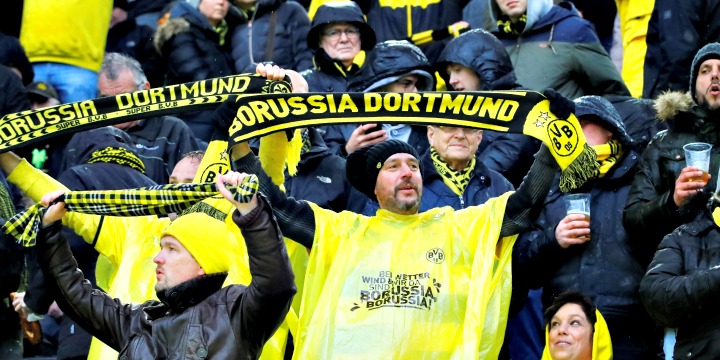
Fans of German soccer club Borussia Dortmund serenade their team. Photo: Reuters/Wolfgang Rattay.
Leaders from international soccer clubs convened on the sidelines of a United Nations Human Rights Council session in Geneva on Wednesday to discuss their respective club’s efforts in addressing antisemitism in sports and call for international support in denouncing hatred following an increase in antisemitic incidents involving soccer fans around the world.
The event, called “Combating Antisemitism in and Through Sports,” was hosted by the World Jewish Congress (WJC) and featured representatives from Germany’s Borussia Dortmund; Greece’s Aris Thessaloniki; the Chelsea Foundation, part of Britain’s Chelsea soccer club; and the Dutch team Feyenoord Rotterdam.
“Sports can serve as a means to promote peace, tolerance and human rights education … We need to continue working together as a community, as a team, to combat all forms of discrimination and hate — not just in football, but in all aspects of our lives,” said Irini Karipidis, president of Aris Thessaloniki, one of the oldest soccer clubs in Greece. She added, “Sports can play a role in promoting social change.”
The Greek soccer club, founded in 1914 by a group of Christians and Jews, held a charity game with the Israeli team Maccabi Haifa in December 2022 to promote inclusivity and the fight against antisemitism, and raised funds for the Holocaust museum in Thessaloniki. The city had a flourishing Jewish community prior to World War II but during the Holocaust almost 50,000 Jews from the city were deported to Nazi concentration camps and only about 2 percent survived, Karipidis noted at Wednesday’s event.
Simon Taylor, head of the Chelsea Foundation, told the group of leaders on Wednesday that he believes soccer “has a unique power: it can inspire, educate and motivate. A game brings people and communities together. Clubs have a responsibility in their communities and its a responsibility that we take extremely serious.”
Taylor then talked about the foundation’s various efforts to draw awareness to hatred and antisemitism, including through it “No to Hate” program with the Anti-Defamation League, and highlighted the mural displayed on a wall outside of the Stamford Bridge soccer stadium that commemorates three Jewish soccer players deported Nazi concentration camps during the Holocaust.
Steven Burger from Feyenoord Rotterdam addressed the club’s disciplinary measures against Dutch fans who sing antisemitic chants at soccer matches, and how the team works with supporters to teach them why the chants are offensive. The club has taken fans to Jewish memorial sites around the Netherlands, developed a Holocaust education workshop with help from the Amsterdam-based Anne Frank House and has even traveled with a group of Feyenoord supporters to visit the Auschwitz concentration camp in Poland.
A report by the Anne Frank House released in February revealed that soccer rivalries in and out of Dutch soccer stadiums are a main trigger for antisemitism in the Netherlands.
Wednesday’s event also marked the launch of the WJC’s new long-term initiative called “Combating Antisemitism in Sport” in collaboration with WhatMatters, a German-based NGO. WJC said in a media release that the initiative will monitor antisemitic activities in sports and “centralize existing knowledge, while serving as an advisory body for stakeholders both inside and outside of sport.”
In early March, Italy’s national soccer authority announced an investigation into supporters of the Roman soccer club Lazio who chanted antisemitic song and making fascist salutes. Lazio also recently imposed lifetime bans on fans who wore jerseys promoting Adolf Hitler and sang antisemitic chants, and Turkey Ministry of National Education said this month it is investigating allegations that members of a Jewish high school soccer team were confronted with Nazi salutes from a rival team.
Among the antisemitic incidents involving soccer supporters that took place in 2022, two London soccer fans harassed a Jewish passenger on a flight with an antisemitic song; an English soccer club lost a sponsor for displaying anti-Israel banners at its matches; and a German youth soccer club was fined and two of its players were suspended after making an antisemitic outburst to their German-Jewish rivals. Antisemitic chants were also sung by fans of the Italian soccer teams Juventus and Inter Milan in September, and Rotterdam soccer fans in the Netherlands who created an antisemitic mural were ordered in July to community service and a mandatory visit to a Holocaust memorial.