







US Government Recorded 33,000 Phone Calls of New York Times Writer Charged as Paid Iranian Agent
Error: Contact form not found.

 by Ira Stoll

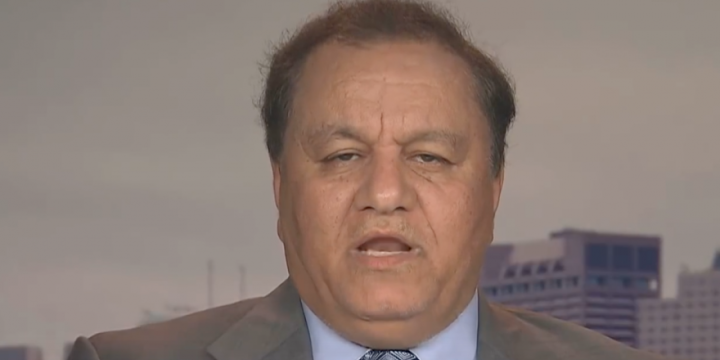
Kaveh Afrasiabi. Photo: Screenshot.
The US government was surreptitiously listening in on the phone calls of a frequent New York Times opinion contributor who now faces federal criminal charges for allegedly being an unregistered foreign agent of Iran.
The Times contributor, Kaveh Afrasiabi, pleaded not guilty in February after being arrested at his Boston-area home.
At an August 25 status hearing, a US attorney handling the case, Ian Richardson, said he was preparing to turn over 33,000 audio recordings of Afrasiabi. An August 27 letter said that in addition to the audio recordings, the government is turning over Internal Revenue Service, health insurance, and banking records.
Afrasiabi told The Algemeiner in an email that the recordings are “the sum of all my phone calls over 13 years maybe even longer, I have better things to do than to listen to my own calls to my family, friends etc. A giant waste of time.”
The federal judge hearing the case, Edward Korman, praised Afrasiabi and admonished the government for dragging out discovery in the case. “For a pro se defendant, you’ve been terrific,” the judge told Afrasiabi. “I have an assistant US attorney who is dragging out discovery to no end.”
Korman said Afrasiabi faced a “worst case scenario” maximum sentence of five years, a little over 4 years with time off for good behavior. Afrasiabi’s standby lawyer, Deirdre Von Dornum, said the prospect that Afrasiabi, who is a permanent resident of the US, could be deported to Iran if convicted, “terrifies me and Dr. Afrasiabi.”
Korman wondered aloud, “Do we actually, given our view of the Iranian government, deport people to Iran?”
The “a little over four years” comment about a potential sentence was a positive sign for Afrasiabi. The prosecutors’ press release when the criminal complaint against Afraisiabi was unsealed said, “If convicted of both charged offenses, Afrasiabi faces a maximum sentence of 10 years in prison.” Judge Korman has indicated previously that he didn’t think much of the conspiracy charge that accompanied the failure to register under the Foreign Agents Registration Act charge, describing it as “a common form of charging to unnecessarily complicate cases.”
The judge lifted a court-ordered curfew that had applied to Afrasiabi. “He’s not going to skip to Iran. If he wanted to run elsewhere he would have done so already,” Korman said.
Judge Korman also cautioned Afrasiabi against incautious remarks. When Afrasiabi started talking about how he had participated in Track Two diplomacy under the auspices of the United Nations Association of the USA, Korman cut him off. “Half of the things you say are self-incriminating,” the judge said. “You should be careful, because everything you say can be used against you.”
Prosecutors say he was paid approximately $265,000 by the Iranian UN mission since 2007 and also received health insurance benefits. Afrasiabi has acknowledged to The Algemeiner that he received the money.
The New York Times, which was publishing frequent op-eds and even letters to the editor from Afrasiabi denouncing “Israel’s neocolonial expansionism” and “the growing apartheid-like cantonization of Arab areas manned by some 700 Israeli checkpoints, not to mention alarming signs of growing violence by vigilante Jewish settlers against the Palestinians,” has yet to publish a word about the criminal case against Afrasiabi. (It has, however, provided energetic-to-the-point-of-breathless front-page coverage of other Foreign Agents Registration Act cases involving allies of former President Trump.) The Times failed to disclose to its readers that Afrasiabi was being paid by the Iranian UN Mission, and it hasn’t appended notes to Afrasiabi’s articles, which remain readily available on the paper’s website.
Afrasiabi has insisted that the articles were written not as Iranian propaganda but “an agent of peace committed to US-Iran reconciliation and peace and dialogue.” In a court affidavit, Afrasiabi wrote, “I never wrote any book or article at the instruction of Iran Mission, nor did I ever waiver from my own independent standards in my publications. At times, my writings were at variance with Iran’s positions.”
Ira Stoll was managing editor of the Forward and North American editor of the Jerusalem Post. His media critique, a regular Algemeiner feature, can be found here.